
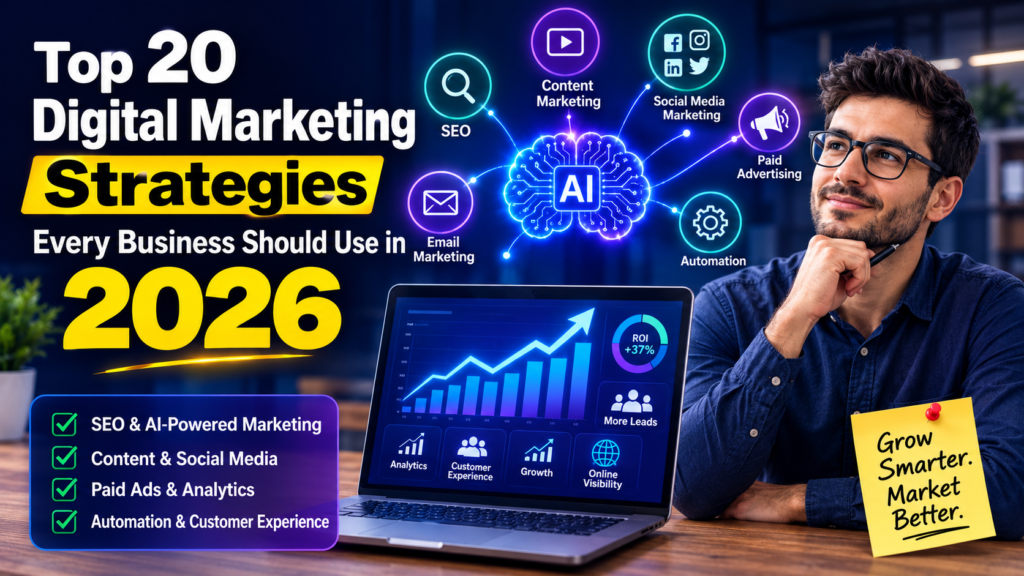
Digital marketing in 2026 goes far beyond maintaining a website, publishing social media posts, or running occasional ads. Businesses now need an integrated approach that brings together SEO, artificial intelligence, content marketing, social media, paid advertising, analytics, automation, and customer experience.
The way people search for information is evolving as well. Google is introducing more AI-powered search experiences, including AI Overviews and AI Mode, while businesses can use Search Console to gain insights into how different types of content perform across Google Search. Despite these changes, strong SEO fundamentals and high-quality, useful content remain important for improving online visibility.
This creates both challenges and opportunities in digital marketing for business growth .
Whether you run a startup, local business, e-commerce company, professional service, or established brand, the goal remains the same:
Reach the right audience, build trust, generate qualified leads, and convert those leads into customers.
In this guide, we’ll explore the 20 digital marketing strategies every business should consider using in 2026, along with practical ways to implement them.
1. Search Engine Optimization (SEO)
SEO remains one of the most important long-term digital marketing strategies.
When potential customers search for products, services, or solutions online, businesses want their websites to appear where those customers are looking.
SEO helps improve a website’s visibility in organic search results.
A modern SEO strategy should include:
- Keyword research
- Search intent analysis
- Helpful content
- On-page SEO
- Technical SEO
- Internal linking
- Local SEO
- Digital PR and relevant links
- Image optimization
- Structured data where appropriate
- Content updates
- Performance monitoring
Why SEO matters in 2026
Search is becoming increasingly conversational and AI-assisted, but Google continues to emphasize the importance of fundamental SEO practices for its generative search experiences.
Businesses should therefore avoid treating AI search optimization as a replacement for SEO.
Instead:
Traditional SEO + High-quality content + Strong brand presence + AI-search visibility
should work together.
Practical tip
Don’t create content solely because a keyword has search volume.
Create content that genuinely answers what your target customer wants to know.
2. AI-Powered Digital Marketing
Artificial intelligence has become one of the biggest developments AI in digital marketing
Businesses can use AI to support:
- Content ideation
- Customer research
- SEO research
- Social media planning
- Email marketing
- Data analysis
- Lead qualification
- Personalization
- Advertising
- Marketing automation
- Customer support
The important distinction is that AI should support marketing teams rather than eliminate strategic human involvement.
A useful workflow is:
AI assistance → Human expertise → Review → Publish → Measure → Improve
AI can make repetitive tasks faster, but businesses still need human judgment for brand positioning, accuracy, creativity, customer relationships, and strategy.
3. Optimize for AI Search and Conversational Search
Search is evolving beyond traditional blue links.
Google’s current guidance includes optimization for generative AI features such as AI Overviews and AI Mode. Google also emphasizes that the underlying SEO fundamentals remain important.
This means businesses should create content that can clearly answer conversational questions.
Instead of targeting only:
“Digital marketing agency Mumbai”
also consider questions such as:
“How can a small business in Mumbai generate more customers online?”
Create content around:
- Questions
- Problems
- Comparisons
- Solutions
- How-to searches
- Product/service decisions
- Local intent
Important
Don’t try to manipulate AI search results with artificial mentions or spam.
Focus on becoming a reliable source of information.
4. Content Marketing
Content marketing remains a powerful strategy for building visibility and trust.
Businesses can create:
- Blog posts
- Guides
- Case studies
- Videos
- Infographics
- Checklists
- E-books
- Webinars
- Social media content
- Customer stories
The best content solves a problem.
For example, instead of publishing:
“Why Our Company Is the Best”
create:
“10 Common SEO Mistakes Small Businesses Should Avoid.”
The second topic provides immediate value to the reader.
Content marketing formula
Customer problem → Useful information → Trust → Consideration → Conversion
5. Short-Form Video Marketing
Short-form video continues to be an important way for brands to capture attention.
Businesses can create short videos for:
- Instagram Reels
- YouTube Shorts
- TikTok where available and appropriate
Content ideas include:
- Tips
- Tutorials
- Product demonstrations
- Behind-the-scenes content
- FAQs
- Customer stories
- Industry insights
- Before-and-after examples
- Myth vs reality
- Quick explanations
A simple video structure
Hook → Problem → Solution → Example → CTA
For example:
“Your website gets visitors but no leads? Here are three things you should check.”
Then explain the three points.
Short-form content doesn’t need an enormous production budget.
Useful information + strong presentation + consistency can be more important than expensive equipment.
6. Social Media Marketing
Social media remains an important channel for brand discovery, social media marketing for small businesses, community building, customer communication, and lead generation.
Businesses should avoid being active on every platform simply because it exists.
Instead, identify where your audience spends time.
For example:
LinkedIn: B2B, professionals, consultants
Instagram: Visual brands, creators, lifestyle businesses
YouTube: Education, tutorials, reviews, long-form video
Facebook: Communities, local businesses, broader demographics
The best social media strategy combines:
- Educational content
- Entertainment
- Engagement
- Social proof
- Brand stories
- Promotional content
7. Personal Branding
People often connect with people before they connect with companies.
Personal branding can be especially powerful for:
- Consultants
- Coaches
- Freelancers
- Agency owners
- Founders
- Real estate professionals
- Financial professionals
- Educators
- Digital marketers
Share:
- Expertise
- Opinions
- Experiences
- Lessons
- Case studies
- Industry observations
A strong personal brand can increase:
Visibility → Trust → Authority → Leads
This doesn’t mean the founder has to become an influencer.
It means making the expertise behind the business visible.
8. Local SEO
Local SEO strategies for businesses serving specific geographic areas, local SEO can be one of the highest-value strategies.
Important local SEO activities include:
- Google Business Profile optimization
- Local keyword targeting
- Reviews
- Accurate business information
- Location pages
- Local content
- Relevant local citations
- Local links
- Consistent NAP information
For example, a business serving Mumbai shouldn’t simply target:
“digital marketing services”
It may also target relevant local searches such as:
“digital marketing consultant in Mumbai”
or specific service-area searches when they genuinely match the business.
Don’t create fake location pages
If a business doesn’t actually serve a location, it shouldn’t create misleading pages just to target that keyword.
9. Google Business Profile Optimization
For local businesses, the Google Business Profile can be an important part of the customer journey.
Keep your profile accurate and updated.
Focus on:
- Correct business name
- Accurate category
- Phone number
- Website
- Business hours
- Services
- Photos
- Posts where useful
- Customer reviews
- Responses to reviews
Reviews are particularly important because they influence customer trust.
Businesses should encourage genuine reviews and avoid fake or incentivized reviews.
Google updated its review-related guidance in 2026 to address fake and undisclosed incentivized reviews. (Google for Developers)
10. Google Ads and Paid Search
SEO is valuable, but organic visibility takes time.
Paid search can help businesses reach people who are actively searching for relevant products or services.
Google Ads can be useful for:
- Lead generation
- E-commerce
- Local services
- High-intent keywords
- Product searches
- Remarketing
A successful campaign requires more than simply choosing keywords.
You need:
Keyword → Ad → Landing Page → Offer → Conversion Tracking
If the landing page doesn’t match the advertisement, performance can suffer.
11. Meta Advertising
Businesses can use advertising across Meta’s platforms to reach specific audiences and support:
- Brand awareness
- Lead generation
- Website traffic
- Product sales
- Retargeting
- App promotion
Creative is particularly important.
Test different:
- Hooks
- Images
- Videos
- Offers
- Headlines
- Calls to action
Don’t assume that one advertisement will work for every audience.
Run structured tests and evaluate actual business results.
Meta also continues to update its advertising formats and delivery environments; for example, it introduced updated full-screen Audience Network formats during 2026. (Facebook)
12. Retargeting
Many visitors won’t purchase or enquire during their first interaction with a business.
Retargeting allows businesses to reconnect with audiences who have already interacted with their:
- Website
- Products
- Social media
- Ads
- Content
For example:
A customer visits a product page but doesn’t purchase.
Later, they see an advertisement reminding them about the product.
Retargeting can help move people further down the funnel.
However, frequency and relevance matter.
Too many repetitive ads can create a poor customer experience.
13. Email Marketing
Email remains valuable because businesses can communicate directly with an audience that has chosen to receive their messages.
Use email for:
- Newsletters
- Promotions
- Product updates
- Educational content
- Lead nurturing
- Customer onboarding
- Re-engagement
- Personalized recommendations
A basic funnel might look like:
Visitor → Email Subscriber → Lead → Customer → Repeat Customer
Don’t only send promotional emails.
Provide useful information.
14. Marketing Automation
Marketing automation can help businesses reduce repetitive manual work.
Examples include:
- Welcome emails
- Lead notifications
- Follow-up emails
- Appointment reminders
- Customer onboarding
- Lead scoring
- Abandoned-cart workflows
- Re-engagement campaigns
For example:
Website form submitted
↓
Lead enters CRM
↓
Automatic confirmation email
↓
Sales notification
↓
Follow-up
↓
Sales conversation
Automation can save time, but businesses should ensure that important customer interactions can still be handled personally.
15. Conversion Rate Optimization
Getting traffic is only half the job.
The next question is:
What happens after someone reaches your website?
Conversion Rate Optimization (CRO) focuses on improving the percentage of visitors who take desired actions.
These actions could include:
- Buying a product
- Filling out a form
- Booking a consultation
- Calling a business
- Downloading a guide
- Signing up for an email list
Improve:
- Headlines
- CTAs
- Page speed
- Forms
- Trust signals
- Testimonials
- Pricing clarity
- Product information
- Navigation
Sometimes improving an existing landing page can produce more value than simply buying more traffic.
16. Influencer and Creator Marketing
Consumers increasingly discover products through creators and online personalities.
Businesses don’t necessarily need celebrity influencers.
Micro and niche creators can sometimes provide more relevant audiences.
When choosing creators, evaluate:
- Audience relevance
- Engagement quality
- Content style
- Credibility
- Brand fit
- Audience location
- Previous collaborations
Don’t select an influencer purely because they have a large follower count.
A smaller but highly relevant audience can be more valuable.
17. Community Marketing
Businesses can build communities around:
- Facebook Groups
- Discord
- Forums
- Email communities
- Customer groups
Community marketing is different from broadcasting advertisements.
The objective is to create a space where customers can:
- Ask questions
- Share experiences
- Learn
- Give feedback
- Connect with others
A strong community can create loyalty and advocacy.
18. Customer Reviews and Social Proof
People want evidence before making purchasing decisions.
Use legitimate social proof such as:
- Customer reviews
- Testimonials
- Case studies
- Ratings
- Before-and-after examples
- Client results
- User-generated content
Don’t manufacture testimonials.
Don’t purchase fake reviews.
Instead, create a process for asking satisfied customers for honest feedback.
Example
After successfully completing a project:
“We’re glad you were happy with the service. If you’d like, we’d appreciate an honest review about your experience.”
Authentic reviews are more valuable than artificially inflated ratings.
19. Data-Driven Marketing and Analytics
Marketing decisions should increasingly be based on evidence rather than assumptions.
Track:
- Traffic
- Leads
- Conversion rate
- Cost per lead
- Customer acquisition cost
- Revenue
- Return on ad spend
- Engagement
- Search performance
- Email performance
For SEO, Google Search Console remains important. In 2026, Google also expanded Search Console’s platform-property capabilities so businesses and creators can analyze social and video content performance on Google Search, Discover, and Google News. (Google for Developers)
Ask better questions
Don’t just ask:
“How much traffic did we get?”
Ask:
“Which traffic generated qualified customers?”
That’s a much more useful business question.
20. Omnichannel Digital Marketing
The final strategy is to connect all the others.
Customers rarely follow a perfectly linear journey.
Someone might:
- See an Instagram Reel
- Search the brand on Google
- Read a blog
- Watch a YouTube video
- Visit the website
- Leave
- See a retargeting ad
- Read reviews
- Receive an email
- Finally make a purchase
Your marketing channels should therefore work together.
Think of your digital ecosystem as:
SEO
Content
Social Media
Paid Ads
Analytics
AI
Customer Experience
This creates a more consistent customer journey.
How to Choose the Right Digital Marketing Strategies
Digital marketing lead generation strategies, you don’t need to implement all 20 strategies simultaneously.
Start with your business model.
If you’re a local business
Prioritize:
- Local SEO
- Google Business Profile
- Reviews
- Social media
- Google Ads
- WhatsApp/customer communication
If you’re an e-commerce business
Prioritize:
- SEO
- Product content
- Google Ads
- Meta Ads
- Retargeting
- Email marketing
- Conversion optimization
If you’re a B2B business
Prioritize:
- SEO
- Content marketing
- Personal branding
- Email marketing
- Lead generation
- Marketing automation
If you’re a consultant or freelancer
Prioritize:
- Personal branding
- SEO
- Short-form video
- Content marketing
- Email marketing
- Lead generation
How AI Changes These 20 Strategies
AI isn’t really a separate activity that sits outside digital marketing.
It can support almost every strategy.
For example:
| Strategy | AI Application |
|---|---|
| SEO | Research and content analysis |
| Content | Ideation and drafting assistance |
| Social Media | Content variations |
| Personalization and drafting | |
| Ads | Creative variations |
| Analytics | Data summaries |
| Customer Support | FAQ assistance |
| Lead Generation | Lead qualification |
| Automation | Workflow assistance |
| Video | Script development |
The best approach is:
AI + Human Expertise + Data + Strategy
rather than:
AI-generated content at scale.
Common Digital Marketing Mistakes to Avoid in 2026
1. Trying Every New Platform
You don’t need to be everywhere.
Focus on platforms that matter to your customers.
2. Publishing AI Content Without Review
AI can make mistakes or produce generic information.
Always review important content.
3. Buying Fake Reviews
Fake reviews can damage trust and violate platform policies.
4. Focusing Only on Traffic
Traffic doesn’t automatically equal revenue.
Track leads and customers.
5. Ignoring Mobile Users
Your website and landing pages should work well on mobile devices.
6. Neglecting Existing Customers
Acquiring customers is important, but retention and repeat business can be equally valuable.
7. Copying Competitors
Use competitors for research—not duplication.
8. Ignoring Brand Building
Performance marketing can generate immediate results, but strong brands can create long-term advantages.
A Simple Digital Marketing Strategy for 2026
If you’re a small business starting from scratch, use this framework.
Step 1: Define Your Audience
Identify:
- Who they are
- What they need
- What problems they face
- What influences their buying decision
Step 2: Build a Strong Website
Make sure your website clearly explains:
- What you offer
- Who you help
- Why customers should trust you
- How to contact you
Step 3: Build Search Visibility
Start with:
- SEO
- Local SEO if relevant
- Helpful content
- Google Business Profile
Step 4: Build Social Presence
Choose one or two platforms where your audience is active.
Step 5: Create Content
Develop useful:
- Blogs
- Videos
- Social posts
- Guides
- Case studies
Step 6: Add Paid Advertising
Once your offer and conversion process are clear, test paid campaigns.
Step 7: Add Email and Automation
Build systems for nurturing leads and customers.
Step 8: Measure Everything Important
Identify what’s generating actual business results.
Step 9: Use AI Strategically
Automate repetitive work without sacrificing quality.
Step 10: Continuously Improve
Digital marketing isn’t a one-time project.
It’s an ongoing process.
Digital Marketing Strategy Checklist for 2026
Before launching your marketing plan, ask:
- Do we know our target audience?
- Is our website optimized for conversions?
- Are we investing in SEO?
- Are we creating useful content?
- Are we active on the right social platforms?
- Are we using short-form video?
- Are we building our brand?
- Are we optimizing for local search if relevant?
- Are we collecting genuine customer reviews?
- Are we using paid advertising strategically?
- Do we have retargeting?
- Are we using email marketing?
- Are repetitive workflows automated?
- Are we monitoring conversions?
- Are we using analytics?
- Are we testing different creative approaches?
- Are we using AI responsibly?
- Are we building customer relationships?
- Are we measuring ROI?
- Are we updating our strategy regularly?
Frequently Asked Questions
What is the most effective digital marketing strategy in 2026?
There isn’t one strategy that works best for every business. SEO, content marketing, social media, paid advertising, email, local SEO, AI-assisted marketing, and conversion optimization can all be effective depending on the audience, business model, goals, and budget.
Is SEO still important in 2026?
Yes. Google continues to state that SEO best practices remain relevant to its AI-powered search experiences. (Google for Developers)
However, SEO increasingly needs to be combined with high-quality content, strong brand signals, and useful multimedia content.
Should businesses use AI for digital marketing?
Yes, when it solves a real business problem. AI can assist with research, content, analytics, personalization, automation, and other marketing tasks. Human review and strategy remain important.
How much should a small business spend on digital marketing?
There is no universal percentage or budget that works for every business. Budget should depend on revenue, margins, customer acquisition economics, competition, business goals, and the channels being used.
Is social media enough for a business?
Usually, relying on one channel creates unnecessary risk. A stronger strategy combines social media with owned assets such as a website, email list, customer database, and other relevant channels.
What should a new business focus on first?
Start with:
Audience → Offer → Website → SEO/Local SEO → Content → Social Media → Lead Generation → Measurement
Then add paid advertising and automation as your foundation becomes stronger.
Final Thoughts
Digital marketing in 2026 is becoming more connected, more automated, and increasingly influenced by AI.
But the fundamentals haven’t disappeared.
Businesses still need to:
Understand customers.
Create valuable experiences.
Build trust.
Be visible where customers search.
Communicate consistently.
Measure results.
The 20 strategies covered in this guide—from SEO and AI marketing to social media, local SEO, paid advertising, email, automation, analytics, and community building—shouldn’t be treated as 20 separate tasks.
They should work together as one digital growth system.
For most businesses, the best approach is not to implement everything at once.
Start with the strategies most closely connected to your customers and business goals. Build a strong foundation, measure the results, and expand gradually.
And remember one of the most important principles of digital marketing in 2026:
Don’t chase every new technology. Use technology to solve real customer and business problems.
When strategy, content, technology, data, and human expertise work together, digital marketing becomes more than a way to generate traffic—it becomes a system for building visibility, trust, leads, customers, and long-term business growth.
About the Author
Digital Adnan Khan is a certified digital marketing consultant in Mumbai specializing in SEO, social media marketing, Google Ads, Meta Ads, content marketing, local SEO, and AI-powered marketing strategies. He helps businesses improve online visibility, generate quality leads, and build sustainable digital growth.