
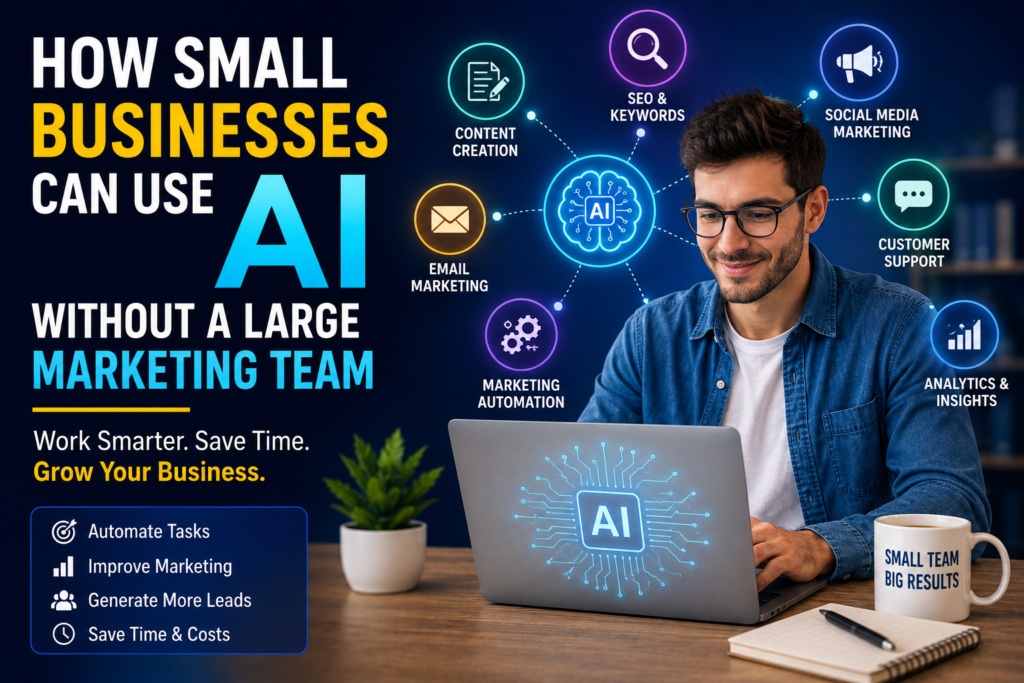
Artificial intelligence has changed the way businesses approach marketing. Tasks that once required hours of research, writing, analysis, design, customer communication, and campaign management can now be supported by AI-powered tools.
For large companies with dedicated marketing departments, adopting AI may seem straightforward. They can assign specialists to test new tools, create workflows, analyze data, and manage automation.
But what about small businesses?
A small business may have only one marketing employee—or the business owner may be handling marketing alongside sales, operations, customer service, and administration. Hiring a large marketing team isn’t always practical, especially when the business is still growing.
The good news is that small businesses don’t need a large marketing team to benefit from AI.
AI in digital marketing can help small businesses save time, create better content, understand customers, improve marketing campaigns, automate repetitive tasks, and make more informed decisions. The key is not to use AI for everything. Instead, businesses should identify repetitive or time-consuming marketing activities and use AI strategically while keeping human judgment at the center.
In this guide, we’ll explore how small businesses can use AI without a large marketing team, the best AI use cases for digital marketing, practical workflows, common mistakes, and a step-by-step AI marketing strategy that small businesses can implement.
What Is AI Marketing for Small Businesses?
AI marketing refers to using artificial intelligence technologies to assist with marketing activities such as:
- Content creation
- Customer research
- SEO
- Keyword research
- Social media management
- Email marketing
- Advertising
- Data analysis
- Customer support
- Personalization
- Lead generation
- Marketing automation
- Content repurposing
AI doesn’t necessarily mean handing your entire marketing operation over to a machine.
Instead, think of AI as a marketing assistant that can help your existing team work faster and more efficiently.
For example, instead of spending three hours brainstorming social media ideas, a marketer can use AI to generate initial concepts in minutes and then spend more time refining the ideas, adding expertise, and making them relevant to the brand.
The human still makes the important decisions.
Why AI Is Important for Small Businesses
Small businesses often face several marketing challenges:
- Limited budgets
- Small teams
- Limited time
- Lack of specialized expertise
- Difficulty producing content consistently
- Limited data analysis resources
- Competition from larger businesses
- Difficulty managing multiple marketing channels
AI can help address some of these challenges.
1. AI Can Save Time
AI can assist with repetitive tasks such as brainstorming, summarizing information, creating content outlines, organizing data, and generating variations of marketing copy.
2. AI Can Improve Productivity
A small team can potentially accomplish more when AI handles portions of repetitive workflows.
3. AI Can Support Better Decision-Making
AI-assisted analytics can help marketers identify patterns and organize large amounts of information.
4. AI Can Help With Personalization
Businesses can create more relevant customer communication based on audience segments and customer needs.
5. AI Can Make Marketing More Accessible
Small businesses can access capabilities that previously required specialized resources, although quality still depends on strategy and human oversight.
The objective isn’t to replace people.
The objective is to help a small team do more meaningful work with the resources it already has.
Can a Small Business Use AI Without a Marketing Team?
Yes.
A business doesn’t necessarily need a dedicated AI specialist or large marketing department to start.
A small business might begin with:
Business Owner + AI Tools + Simple Marketing Workflow
For example, an owner could use AI to help:
- Research customer questions
- Develop content ideas
- Create a content outline
- Draft a first version
- Review and personalize the content
- Create social media variations
- Analyze basic performance data
- Improve future content
However, AI should not be treated as an automatic replacement for expertise.
The business owner still needs to decide:
- What the brand stands for
- Who the customers are
- What products or services to promote
- What claims are accurate
- What content reflects the brand
- Which marketing activities deserve investment
- What customer feedback means
How Small Businesses Can Use AI for Digital Marketing
There are many ways small businesses can integrate AI into their marketing.
The most useful applications are often the ones that reduce repetitive work while leaving strategic decisions to humans.
1. Use AI for Customer Research
Before creating marketing campaigns, businesses need to understand their customers.
AI can help organize and analyze customer research.
For example, a business can collect:
- Customer reviews
- Frequently asked questions
- Sales enquiries
- Customer support conversations
- Survey responses
- Product feedback
- Social media comments
AI can then help identify recurring themes.
You might discover that customers frequently ask:
- How much does the service cost?
- How long does delivery take?
- Is there a warranty?
- How does the service work?
- What makes your product different?
- Is the service available in my area?
These questions can become marketing content.
Practical Workflow
Customer feedback → AI analysis → Common questions → Content ideas → Marketing content
This is particularly useful for small businesses because it turns information they already have into marketing opportunities.
2. Use AI for Content Ideas
Creating fresh content consistently can be difficult when one person manages multiple responsibilities.
AI can help generate content ideas based on:
- Customer problems
- Industry topics
- Products
- Services
- Frequently asked questions
- Seasonal events
- Educational topics
- Common mistakes
- Customer objections
For example, a local digital marketing consultant could create topics such as:
- 5 SEO mistakes small businesses make
- How to improve your Google visibility
- Digital marketing tips for local businesses
- How social media helps small businesses
- How AI can support marketing
- Common Google Ads mistakes
The important step is adding human expertise afterward.
AI-generated ideas should be evaluated before publication.
3. Use AI to Create Content Outlines
AI can be useful for structuring long-form content.
Suppose a small business wants to write:
“Complete Guide to Local SEO for Small Businesses.”
AI can help organize possible sections:
- What is local SEO?
- Why local SEO matters
- Google Business Profile
- Local keywords
- Reviews
- Local content
- Citations
- Local links
- Common mistakes
- Measuring performance
The marketer can then decide which sections are genuinely useful.
This can reduce planning time without eliminating the editorial process.
4. Use AI for Blog Content—But Don’t Publish Blindly
AI can assist with drafting blog content, but businesses should avoid simply generating an article and publishing it without review.
A better process is:
Research → Outline → AI-assisted draft → Human review → Expert additions → Fact-check → Edit → Publish
Add:
- Original examples
- First-hand experience
- Customer insights
- Industry-specific information
- Original opinions
- Case studies
- Relevant data
- Clear explanations
This makes the content more useful and less generic.
Search engines increasingly emphasize useful, reliable, people-first content. AI should therefore support the content process rather than become an excuse to publish large volumes of low-value pages.
5. Use AI for SEO
SEO can involve many repetitive activities.
AI can assist with:
- Keyword brainstorming
- Search-intent classification
- Topic clustering
- Content outlines
- Meta title ideas
- Meta descriptions
- Internal-link suggestions
- Content gap analysis
- FAQ ideas
- Content optimization
- Competitor topic analysis
For example, a small business targeting:
“SEO services for small businesses”
could use AI to brainstorm related topics:
- Small business SEO tips
- Local SEO
- Technical SEO
- On-page SEO
- Keyword research
- Google Business Profile
- Link building
- SEO reporting
The marketer still needs to validate keyword relevance and search intent using appropriate SEO tools and actual search results.
AI can accelerate the process.
It shouldn’t replace SEO strategy.
6. Use AI to Improve Existing Content
AI isn’t only useful for creating new content.
It can also help identify opportunities in existing content.
For example, an older blog post may have:
- Outdated information
- Weak headings
- Missing questions
- Poor structure
- Repetitive paragraphs
- Weak calls to action
- Missing internal links
AI can help identify potential improvements.
A useful workflow is:
Existing article → Content audit → Identify gaps → Human review → Update → Re-publish
This can be more valuable than continuously creating new articles.
7. Use AI for Social Media Content
Social media requires consistency.
Small businesses may struggle to post regularly because creating captions, ideas, hooks, and variations takes time.
AI can help generate:
- Instagram captions
- LinkedIn post ideas
- Carousel concepts
- Reel hooks
- Video scripts
- Story ideas
- Poll questions
- Content calendars
- Hashtag ideas
- Content repurposing suggestions
For example, one blog post can become:
1 Blog → 1 LinkedIn post → 1 Instagram carousel → 2 Reels → 5 short posts → 3 Stories
AI can help adapt the core idea into different formats.
The business should still adjust each version to match the platform and its audience.
8. Use AI for Social Media Content Calendars
Creating a monthly content calendar can be time-consuming.
AI can help organize content around categories such as:
Educational
Teach customers something useful.
Promotional
Showcase products or services.
Engagement
Ask questions and encourage conversations.
Authority
Share expertise and insights.
Social Proof
Show testimonials, reviews, and case studies.
Behind the Scenes
Show the people and processes behind the business.
A simple content mix might look like:
40% Educational
20% Engagement
20% Authority
10% Social Proof
10% Promotional
The exact mix should depend on the business and audience.
9. Use AI for Content Repurposing
One of the biggest advantages of AI for small businesses is content repurposing.
Instead of creating everything from scratch, businesses can transform one valuable piece of content into multiple assets.
For example:
One Blog Post
↓
LinkedIn article
↓
Instagram carousel
↓
Short video script
↓
Email newsletter
↓
FAQ
↓
YouTube video outline
↓
Social media captions
This helps small teams maintain consistency without constantly starting from zero.
10. Use AI for Email Marketing
Email marketing is another area where AI can assist.
AI can help with:
- Subject line ideas
- Email outlines
- Newsletter ideas
- Personalization suggestions
- Follow-up sequences
- Customer segmentation
- A/B test ideas
- Re-engagement campaigns
For example, an online store might create different messages for:
- New subscribers
- Existing customers
- Repeat buyers
- Abandoned-cart users
- Inactive customers
The business should still ensure that email communication follows applicable privacy, consent, and marketing requirements.
11. Use AI for Lead Generation
Small businesses often need leads but don’t have large sales and marketing teams.
AI can support lead generation through:
- Chatbots
- Lead qualification
- Website forms
- Personalized messages
- Content recommendations
- Follow-up workflows
- Customer segmentation
For example, a website chatbot could answer common questions and direct visitors toward:
Book a Consultation
Request a Quote
Contact Sales
Learn More
This can reduce repetitive questions for a small team.
However, businesses should ensure that customers can reach a human when the situation requires human judgment.
12. Use AI for Customer Support
Customer support can consume a significant amount of time.
AI-assisted chat systems can help answer repetitive questions such as:
- Business hours
- Delivery information
- Basic product details
- Service areas
- Appointment processes
- Frequently asked questions
For example:
“Do you provide digital marketing services for local businesses?”
An AI assistant could provide a basic answer and direct the visitor to a relevant service page.
For complex issues, complaints, sensitive situations, or exceptions, human support should take over.
13. Use AI for Advertising
Advertising platforms already use automation and machine learning in various ways.
Small businesses can also use AI to assist with campaign preparation.
AI can help generate:
- Ad copy variations
- Headline ideas
- Audience hypotheses
- Creative concepts
- Landing page messaging
- Testing ideas
- Performance summaries
For example, instead of creating one headline, a marketer can develop several variations and test which message resonates best.
The actual campaign strategy should still be based on business goals, customer data, budget, and performance.
14. Use AI to Analyze Marketing Data
Data analysis can be difficult when a small business doesn’t have a dedicated analyst.
AI can help summarize marketing information and identify patterns.
For example, businesses can analyze:
- Website traffic
- Lead sources
- Conversion rates
- Advertising performance
- Social engagement
- Email performance
- Customer acquisition data
The goal isn’t simply to generate reports.
The goal is to answer questions such as:
What channel is producing the best leads?
Which campaigns are generating customers?
What pages have strong traffic but weak conversions?
Which content attracts the right audience?
These insights can help guide future marketing decisions.
15. Use AI for Competitor Research
Small businesses can use AI to organize competitor research.
You might analyze:
- Competitor services
- Content topics
- Positioning
- Customer reviews
- Common customer complaints
- Marketing messages
- Frequently asked questions
The goal shouldn’t be to copy competitors.
Instead, look for opportunities to differentiate.
For example:
If competitors focus heavily on price, your business could emphasize:
- Expertise
- Service quality
- Faster support
- Customization
- Experience
- Customer education
AI can help organize information, but strategic positioning still requires human thinking.
16. Use AI to Improve Customer Personalization
Customers don’t always respond to generic messages.
AI can help businesses create more relevant experiences based on customer segments.
For example:
New Customer
“Welcome! Here’s how to get started.”
Existing Customer
“Here’s how to get more value from your purchase.”
Returning Customer
“Here are products or services that may complement your previous purchase.”
Personalization can improve relevance, but businesses should avoid using personal data in ways that customers wouldn’t reasonably expect.
Privacy and transparency remain important.
17. Use AI for Local Marketing
Local businesses can use AI to support local marketing activities.
For example, a business can use AI to brainstorm content around:
- Local customer questions
- Neighborhood-specific topics
- Local events
- Service-area pages
- Frequently asked questions
- Location-specific offers
A Mumbai-based business might create useful content around the needs of customers in different areas it genuinely serves.
However, businesses should avoid generating dozens of nearly identical location pages with little unique value.
Local content should be genuinely useful.
18. Use AI to Create Video Scripts
Video marketing can be challenging for small teams.
AI can help structure:
- Reels
- YouTube videos
- Explainer videos
- Product demonstrations
- Educational videos
- Customer FAQs
A simple short-form video structure could be:
Hook → Problem → Solution → Example → CTA
For example:
“Your website gets traffic but no enquiries? Here are three things you should check.”
Then explain the three issues.
AI can help with the structure, while the business owner or expert provides authentic experience and delivery.
19. Use AI for Graphic Design Support
AI-powered design tools can help small businesses create marketing assets without requiring a full-time designer.
Businesses can create or support:
- Social media graphics
- Presentation visuals
- Ad concepts
- Infographics
- Thumbnails
- Marketing templates
- Simple promotional designs
However, visual consistency is important.
Maintain:
- Brand colors
- Fonts
- Logo usage
- Tone
- Image style
- Layout consistency
AI can speed up production, but a recognizable brand identity still requires human direction.
20. Use AI for Marketing Automation
Automation becomes especially valuable when a small team has limited time.
A simple workflow might look like:
Website visitor
↓
Lead form
↓
Automatic confirmation
↓
Lead enters CRM
↓
Lead qualification
↓
Sales notification
↓
Follow-up
↓
Customer
AI and automation can reduce manual administrative work.
But automation should not make customer interactions feel robotic.
High-value leads often benefit from personal communication.
21. AI Can Help One Marketer Work Like a Small Team
Consider a small business with one marketing employee.
That person may need to handle:
- SEO
- Social media
- Content
- Ads
- Analytics
- Website updates
AI can support each activity.
For example:
| Marketing Task | AI Assistance |
|---|---|
| Content | Ideas and outlines |
| SEO | Research and optimization support |
| Social Media | Captions and repurposing |
| Drafting and variations | |
| Ads | Copy variations |
| Analytics | Data summaries |
| Customer Support | FAQ assistance |
| Video | Script development |
| Design | Creative concepts |
| Lead Generation | Qualification assistance |
This doesn’t mean one person can suddenly perform ten specialist jobs perfectly.
It means AI can reduce repetitive work and free up time for high-value activities.
22. The Best AI Workflow for Small Businesses
A practical AI workflow looks like this:
Step 1: Identify the Problem
Don’t start with:
“Which AI tool should I use?”
Start with:
“Which marketing task takes too much time?”
Step 2: Measure the Task
How much time does it consume?
Step 3: Identify Where AI Can Help
Determine whether AI can assist with research, drafting, analysis, automation, or personalization.
Step 4: Create a Workflow
Define exactly where AI enters the process.
Step 5: Add Human Review
Check:
- Accuracy
- Brand voice
- Quality
- Context
- Claims
- Customer relevance
Step 6: Measure the Outcome
Do the workflow save time?
Did quality improve?
Did conversion improve?
Step 7: Improve
Continue refining the process.
23. Don’t Use AI for Everything
One of the biggest mistakes small businesses can make is trying to automate every part of marketing.
Some activities require human involvement.
These include:
- Brand strategy
- Customer relationships
- Complex sales conversations
- Creative direction
- Crisis communication
- Business positioning
- High-stakes decisions
- Sensitive customer complaints
- Original thought leadership
AI should handle what it does well.
Humans should handle what humans do well.
The strongest approach is:
AI + Human Expertise
rather than:
AI instead of Humans
24. Common AI Marketing Mistakes Small Businesses Should Avoid
Mistake 1: Publishing Raw AI Content
AI-generated content may contain inaccuracies, generic statements, or outdated information.
Solution: Review and edit everything before publishing.
Mistake 2: Using Too Many AI Tools
Businesses sometimes subscribe to multiple tools without establishing a workflow.
Solution: Start with a small number of tools that solve real problems.
Mistake 3: Chasing Every New AI Tool
The AI market changes rapidly.
A new tool appears almost every week.
You don’t need every tool.
Solution: Focus on outcomes, not novelty.
Mistake 4: Losing Brand Voice
AI-generated content can sound generic.
Solution: Provide clear brand guidelines and add your own perspective.
Mistake 5: Ignoring Accuracy
AI systems can produce incorrect information.
Solution: Fact-check important claims, statistics, technical information, and business details.
Mistake 6: Feeding Sensitive Information Into AI Tools
Businesses may accidentally enter confidential customer or company information into external AI systems.
Solution: Establish clear internal rules about what information employees can enter into AI tools.
Mistake 7: Replacing Human Customer Service Completely
Customers may become frustrated if they cannot reach a person when they need one.
Solution: Use AI for simple requests and provide escalation to human support.
25. AI and SEO: What Small Businesses Need to Know
AI has made content creation easier, but that doesn’t mean every AI-generated article will rank.
Search engines aim to provide useful results that satisfy users.
Small businesses should focus on creating content that demonstrates:
- Experience
- Expertise
- Accuracy
- Relevance
- Originality
- Trustworthiness
For example, instead of creating 50 generic AI-written articles, a local business could publish 10 genuinely useful articles containing:
- Original examples
- Customer questions
- Practical advice
- Industry experience
- Local insights
- Case studies
- Helpful visuals
Quality should come before quantity.
26. AI Search and the Future of Small Business Marketing
Search behavior is changing as AI-powered search experiences become more common.
Customers may increasingly ask conversational questions rather than entering short keywords.
Instead of:
“SEO Mumbai”
a user might search:
“What is the best way for a small business in Mumbai to get more customers from Google?”
This means businesses should create content that directly answers real customer questions.
Useful strategies include:
- Detailed FAQs
- Problem-solving content
- Clear explanations
- Original examples
- Well-structured articles
- Strong topical coverage
- Accurate business information
Small businesses should focus on becoming useful sources of information rather than simply repeating keywords.
27. How to Create an AI Marketing Strategy With a Small Budget
You don’t need an expensive AI stack.
Start with a simple framework.
Stage 1: Content
Use AI to help with ideas, outlines, repurposing, and editing.
Stage 2: SEO
Use AI for research assistance and content planning while validating findings with SEO tools and search data.
Stage 3: Social Media
Use AI to create content variations and calendars.
Stage 4: Customer Support
Use automation for repetitive questions.
Stage 5: Analytics
Use AI-assisted analysis to identify patterns.
Stage 6: Automation
Connect repetitive workflows.
Once these systems prove valuable, the business can expand.
28. A Simple Weekly AI Marketing Workflow
Here’s an example for a small business owner.
Monday — Research
Use customer questions and industry developments to identify content opportunities.
Tuesday — Content
Create one useful blog or long-form piece.
Wednesday — Repurpose
Turn the content into:
- LinkedIn post
- Instagram carousel
- Reel script
Thursday — SEO
Review website performance and identify optimization opportunities.
Friday — Analytics
Review:
- Traffic
- Leads
- Conversions
- Content performance
- Advertising results
Weekend
Plan the next week’s content.
This type of workflow can help a small team maintain consistency without spending every day creating marketing material from scratch.
29. How Small Businesses Should Measure AI’s Impact
Don’t measure AI success simply by asking:
“How much content did AI create?”
Instead, measure business outcomes.
Time Saved
How many hours were saved?
Cost Reduction
Did the business reduce unnecessary operational costs?
Content Output
Can the business produce useful content more consistently?
Lead Generation
Did marketing generate more qualified enquiries?
Conversion Rate
Did more visitors become customers?
Customer Experience
Did response times improve?
Productivity
Can the team focus on higher-value work?
The ultimate question is:
Is AI helping the business achieve better marketing outcomes with its existing resources?
30. AI Marketing Metrics to Track
Small businesses can monitor:
- Website traffic
- Organic traffic
- Leads
- Qualified leads
- Conversion rate
- Cost per lead
- Customer acquisition cost
- Email open rate
- Email click-through rate
- Social engagement
- Advertising ROI
- Content performance
- Time saved through automation
Don’t track dozens of metrics just because they are available.
Focus on metrics connected to business goals.
31. A 30-Day AI Marketing Plan for Small Businesses
Here’s a practical starting plan.
Week 1: Audit
Identify repetitive marketing tasks.
Ask:
- What takes the most time?
- What could be automated?
- What content needs to be created?
- Where are leads being lost?
Week 2: Content System
Use AI to help create:
- Content ideas
- Blog outlines
- Social media concepts
- Video scripts
- Email topics
Create a consistent content workflow.
Week 3: Automation
Automate simple processes such as:
- Lead notifications
- Email confirmations
- Content organization
- Customer FAQ responses
Week 4: Analyze
Compare results.
Ask:
- Did we save time?
- Did content quality improve?
- Did leads increase?
- Did conversions improve?
- Which workflow worked best?
Then improve the system.
32. How AI Can Help Different Types of Small Businesses
AI isn’t limited to digital agencies or technology companies.
Restaurants
AI can assist with:
- Social media ideas
- Menu descriptions
- Customer FAQs
- Promotional campaigns
- Review analysis
Salons
AI can help with:
- Appointment communication
- Social content
- Offers
- Customer segmentation
- FAQs
E-commerce Businesses
AI can support:
- Product descriptions
- Email marketing
- Customer support
- Product recommendations
- Ad copy
Consultants
AI can help with:
- Content creation
- Lead nurturing
- Research
- Presentation preparation
- Social media
Local Service Businesses
AI can assist with:
- Local content
- FAQs
- Lead qualification
- Follow-up
- Customer communication
The exact workflow should be customized to the business.
33. AI Should Strengthen Your Competitive Advantage
AI tools are becoming increasingly accessible.
That means simply saying:
“We use AI”
is unlikely to be a meaningful competitive advantage.
The real advantage comes from how you use AI.
For example:
A competitor may use AI to create generic blog posts.
Your business could use AI to analyze actual customer questions and combine those insights with years of industry experience to create highly useful content.
That’s a stronger strategy.
Your competitive advantage comes from:
AI + Data + Experience + Strategy + Execution
34. Human Expertise Still Matters
AI can process information quickly.
But it doesn’t automatically understand your business the way you do.
You know:
- Your customers
- Their concerns
- Their objections
- Your market
- Your products
- Your competitors
- Your brand
- Your business goals
That knowledge is valuable.
Use AI to amplify it.
For example:
experience + AI assistance = stronger content
Your customer data + AI analysis = better insights
Your strategy + AI automation = greater efficiency
This is where small businesses can gain significant value.
35. The Future of AI for Small Business Marketing
AI adoption will continue influencing digital marketing.
Small businesses should watch developments in:
- AI-powered search
- AI content workflows
- AI marketing assistants
- AI analytics
- Conversational marketing
- Automated customer support
- Personalization
- AI advertising
- AI agents
- Marketing automation
But businesses shouldn’t adopt technology simply because it is trending.
Every tool should answer a business question:
What problem does this solve?
How much time does it save?
Will it improve customer experience?
Can it increase revenue or reduce costs?
If there is no clear answer, the tool may not be necessary.
Frequently Asked Questions
Can a small business use AI without hiring an AI specialist?
Yes. Many AI applications can be integrated into existing marketing workflows without hiring a dedicated AI specialist. Small businesses can begin with simple use cases such as content ideation, research assistance, social media planning, email drafting, data analysis, and customer FAQ support.
What is the best AI tool for a small business?
There isn’t one AI tool that is best for every business. The right tool depends on the specific problem you are trying to solve. Start with your marketing workflow and identify where you need assistance rather than choosing tools based only on popularity.
Can AI replace a small business marketing team?
AI can automate or accelerate certain tasks, but it should not be viewed as a complete replacement for marketing expertise. Strategy, creativity, customer relationships, brand positioning, and business decision-making still require human involvement.
How can AI help small businesses with SEO?
AI can assist with keyword brainstorming, search-intent analysis, content outlines, topic clustering, internal-link suggestions, content audits, and optimization ideas. Businesses should validate AI suggestions using actual search data and SEO tools.
Can AI create social media content for small businesses?
Yes. AI can assist with captions, post ideas, content calendars, carousel concepts, video scripts, and content repurposing. Human editing is important to ensure the content reflects the brand and provides genuine value.
How can AI help generate leads?
AI can support lead generation through chatbots, lead qualification, personalized content, email workflows, customer segmentation, advertising assistance, and follow-up automation. Businesses should ensure that high-value or complex leads can still reach a human representative.
Is AI-generated content good for SEO?
AI can assist with content creation, but automatically generated content isn’t valuable simply because AI produced it. Businesses should focus on original, accurate, useful, people-first content and add genuine expertise, experience, examples, and insights.
How much does AI marketing cost for a small business?
Costs vary considerably. Some AI tools offer free or low-cost options, while advanced platforms may require subscriptions. Businesses should evaluate tools based on the time saved, quality improvements, and business outcomes they generate.
Should small businesses automate customer service with AI?
AI can be useful for repetitive questions and basic support. However, businesses should provide a clear path to human assistance for complex problems, complaints, sensitive situations, or requests that require judgment.
How can a small business start using AI?
Start with one repetitive marketing task. For example, use AI to brainstorm content ideas, summarize customer feedback, or repurpose existing content. Measure the results before expanding AI into other workflows.
Final Thoughts
Small businesses don’t need a large marketing department to benefit from artificial intelligence.
They need a clear strategy, the right workflows, appropriate tools, and human oversight.
AI can help a small team save time and increase its marketing capacity by assisting with:
- SEO
- Content marketing
- Social media
- Email marketing
- Lead generation
- Advertising
- Customer support
- Analytics
- Personalization
- Automation
- Content repurposing
But the most effective approach isn’t to automate everything.
Instead, identify the repetitive tasks that consume valuable time and determine where AI can provide meaningful assistance.
A simple formula is:
Identify → Automate → Review → Measure → Improve
Start small.
Choose one marketing process.
Build a workflow around it.
Measure the result.
Then expand.
The future of small-business marketing isn’t necessarily about having the biggest marketing team. It’s about having a smart combination of people, technology, data, creativity, and strategy.
AI can give small businesses more leverage—but the businesses that use it successfully will be the ones that combine that technology with genuine customer understanding and human expertise.
AI doesn’t have to replace your marketing team. It can help your existing team become more productive, more consistent, and more focused on the work that actually grows the business.
About the Author
Digital Adnan Khan is a certified digital marketer based in Andheri, Mumbai, helping startups, local businesses, professionals, and e-commerce brands improve their online presence, generate qualified leads, and achieve sustainable digital growth.