
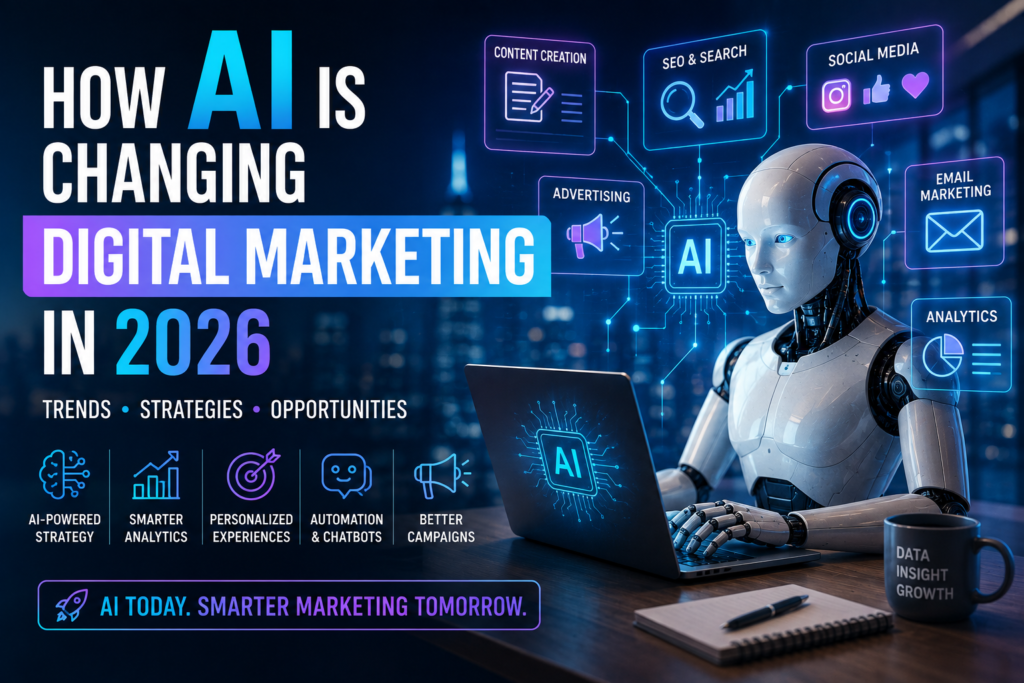
Artificial intelligence has moved from being an emerging technology to becoming an important part of modern digital marketing. In 2026, marketers are using AI not only to generate content but also to analyze customer behavior, personalize campaigns, improve advertising, automate repetitive tasks, understand search intent, and create more conversational customer experiences.
The biggest change is that AI is no longer simply helping marketers work faster. It is increasingly influencing how customers discover brands, how businesses communicate with audiences, and how marketing decisions are made.
Google is evolving Search around AI Overviews and AI Mode, while advertising platforms are increasingly using AI for targeting, creative development, optimization, and campaign automation. At the same time, marketers are experimenting with generative AI, predictive analytics, AI agents, chatbots, and personalization tools.
For businesses, this creates both opportunities and challenges.
AI can help a small business compete more efficiently, but simply using AI-generated content is not enough. Businesses still need strategy, original insights, accurate information, human judgment, and a strong understanding of their customers.
In this guide, we’ll explore how AI is changing digital marketing in 2026, the biggest AI marketing trends, how AI is affecting SEO and advertising, how businesses can use AI effectively, and what marketers should do to stay competitive.
What Is AI in Digital Marketing?
AI in digital marketing refers to the use of artificial intelligence technologies to perform, automate, analyze, or improve marketing activities.
These technologies can process large amounts of data, identify patterns, generate content, predict outcomes, understand language, and support decision-making.
AI can now assist marketers with activities such as:
- Keyword and search-intent research
- Content ideation
- Content creation
- Copywriting
- Image generation
- Video creation
- Customer segmentation
- Personalization
- Social media management
- Advertising optimization
- Lead scoring
- Customer support
- Data analysis
- Predictive marketing
- Email marketing
- Conversational marketing
- Search optimization
However, AI should not be viewed as a replacement for marketing strategy.
The most effective approach is often:
Human strategy + AI assistance + Data + Continuous optimization
A marketer still needs to understand the business, audience, positioning, customer psychology, brand voice, and commercial goals.
Why AI Is Important for Digital Marketing in 2026
The scale and speed of digital marketing have increased significantly.
Customers interact with brands through websites, search engines, social media, email, messaging platforms, apps, advertisements, and AI-powered interfaces.
Managing all these touchpoints manually can be difficult.
AI helps marketers process information and perform repetitive tasks faster.
Salesforce’s 2026 State of Marketing research highlights the growing importance of AI, data, and personalization. Its India findings reported that 81% of surveyed marketers in India had adopted AI, while data quality and disconnected systems remained major barriers to effective personalization.
This illustrates an important point:
AI adoption alone does not guarantee marketing success.
Businesses also need reliable data, clear objectives, strong processes, and human oversight.
1. AI Is Changing How People Search
One of the biggest changes in digital marketing is happening in search.
Traditional search generally required users to enter keywords and browse a list of results.
AI-powered search is becoming more conversational.
Users can now ask longer, more detailed questions and receive AI-generated responses that summarize information from multiple sources.
Google has continued expanding AI Overviews and AI Mode in 2026. Google reported that AI Mode had surpassed one billion monthly users globally, while queries were more than doubling every quarter since launch.
For marketers, this changes the question from:
“How do I rank for this keyword?”
to:
“How do I make my brand and content useful enough to be discovered and referenced in AI-powered search experiences?”
This is contributing to the growth of concepts such as:
- AI Search Optimization
- Answer Engine Optimization
- Generative Engine Optimization
- Entity SEO
- Conversational search optimization
Traditional SEO remains important, but marketers increasingly need to think beyond ten blue links.
2. AI Is Changing SEO
SEO in 2026 is becoming more focused on intent, entities, authority, usefulness, and comprehensive answers.
AI-powered search can understand complex questions and relationships between concepts.
For example, instead of searching:
“SEO Mumbai”
a user might ask:
“What is the best SEO strategy for a small business in Mumbai with a limited marketing budget?”
This is a much more specific question.
A strong SEO strategy should therefore cover:
- The topic
- Search intent
- Related questions
- Practical examples
- User problems
- Supporting evidence
- Relevant entities
- Original insights
- Clear explanations
Google has also introduced new ways to help users find original content and firsthand perspectives within AI Search experiences.
This makes originality and expertise increasingly valuable.
What does this mean for SEO professionals?
Instead of creating hundreds of generic AI-generated articles, marketers should focus on producing content that offers something useful:
- Original research
- Firsthand experience
- Expert commentary
- Case studies
- Unique examples
- Real-world data
- Strong opinions supported by evidence
- Practical processes
AI can help create content faster, but usefulness and credibility remain essential.
3. AI Is Making Content Creation Faster
Content creation is one of the most obvious areas where AI has changed digital marketing.
Marketers can use AI to generate initial ideas for:
- Blog topics
- Headlines
- Social media posts
- Video scripts
- Email campaigns
- Ad copy
- Product descriptions
- Content calendars
- FAQs
For example, a marketer could take one topic:
“Local SEO for Small Businesses”
and use AI to create a content ecosystem:
- Blog article
- Instagram carousel
- LinkedIn post
- Reel script
- YouTube video outline
- Email newsletter
- FAQ section
- Short social posts
This dramatically reduces the time required to repurpose content.
However, there is a major difference between AI-assisted content and low-quality automated content.
AI-generated content without human editing can become repetitive, generic, inaccurate, or disconnected from the brand.
The marketer’s job is therefore changing from simply creating every word manually to:
Research → Strategy → AI assistance → Human editing → Fact-checking → Publishing → Optimization
4. AI Is Increasing the Importance of Human Creativity
It may seem strange, but as AI makes content creation easier, human creativity may become more valuable.
If thousands of businesses can generate similar AI-written articles, generic content becomes easier to produce and harder to differentiate.
Imagine that 500 businesses publish articles about:
“10 Digital Marketing Trends in 2026.”
If every article contains similar information generated from the same AI tools, there is little reason for users to prefer one over another.
The competitive advantage may instead come from:
- Original opinions
- Unique experiences
- Strong storytelling
- Personal examples
- Expert analysis
- Proprietary data
- Case studies
- Better visual content
- Strong brand personality
AI can help marketers produce more.
But humans still need to decide what is worth producing.
5. AI Is Transforming Personalization
Personalization has been a marketing goal for years, but doing it manually at scale has always been difficult.
AI can analyze customer information and help marketers create more relevant experiences.
For example, an e-commerce business could potentially personalize recommendations based on:
- Previous purchases
- Browsing behavior
- Product interests
- Customer segment
- Location
- Engagement history
A B2B company could personalize content according to:
- Industry
- Company size
- Job role
- Previous interactions
- Sales stage
AI can help marketers move from:
One message for everyone
to:
More relevant messages for different customer groups.
Salesforce’s 2026 research identifies AI, data unification, and personalization as central themes in the changing marketing landscape.
However, personalization depends heavily on data quality.
Poor data can produce poor personalization.
6. AI Is Changing Social Media Marketing
Social media marketers are using AI throughout the content workflow.
AI can assist with:
- Content ideas
- Caption drafts
- Hashtag research
- Video scripts
- Creative concepts
- Content calendars
- Audience analysis
- Sentiment analysis
- Social listening
- Performance reporting
For example, a small business could provide AI with information about its:
- Target audience
- Services
- Brand voice
- Products
- Offers
- Content pillars
AI could then help create a month’s worth of content ideas.
But businesses should not allow AI to completely define their social media personality.
Customers want authentic communication.
The best strategy is to use AI for efficiency while keeping human stories, experiences, opinions, and customer interactions at the center of the brand.
7. AI Is Transforming Paid Advertising
Paid advertising platforms are increasingly incorporating AI into campaign creation and optimization.
AI can assist with:
- Audience targeting
- Creative variations
- Budget allocation
- Campaign optimization
- Ad placement
- Performance prediction
- Conversion optimization
Meta, for example, has continued expanding AI-powered advertising products through its Advantage suite, which automates aspects of targeting and delivery. Meta says the suite is designed to help advertisers improve campaign efficiency and reach potential audiences.
This means marketers are increasingly moving from manually controlling every campaign setting toward supervising automated systems.
The role of the marketer becomes:
Set the objective → Provide quality inputs → Monitor performance → Analyze results → Improve strategy
AI handles more of the optimization process, while marketers remain responsible for business decisions.
8. AI Is Improving Ad Creative Testing
Creating multiple versions of an advertisement traditionally required significant design and copywriting resources.
AI can help generate variations of:
- Headlines
- Descriptions
- Images
- Videos
- Calls to action
- Product messaging
A business could test different messages for different customer segments.
For example:
Version A
“Get More Customers From Google.”
Version B
“Improve Your Local Visibility and Generate More Enquiries.”
Version C
“Grow Your Local Business With a Smarter SEO Strategy.”
AI can help generate and organize these variations.
But the marketer still needs to evaluate whether the message accurately represents the business.
More variations do not automatically mean better advertising.
9. AI Is Making Marketing Analytics More Accessible
Marketing generates enormous amounts of data.
Businesses may need to analyze:
- Website traffic
- Search queries
- Conversion rates
- Advertising performance
- Customer acquisition costs
- Social media engagement
- Email performance
- Sales data
AI can help marketers summarize large datasets and identify patterns.
Instead of spending hours manually reviewing reports, marketers can use AI to ask questions such as:
“Which campaigns generated the most qualified leads?”
“Which landing pages have high traffic but low conversion rates?”
“What audience segment has the lowest acquisition cost?”
This can make analytics more accessible to small businesses that don’t have large data teams.
However, AI-generated analysis should always be checked against the underlying data.
10. Predictive Marketing Is Becoming More Practical
Predictive AI uses historical and current data to identify patterns that may help estimate future outcomes.
Marketing applications can include:
- Lead scoring
- Customer churn prediction
- Purchase probability
- Product recommendations
- Audience segmentation
- Demand forecasting
For example, a CRM system might identify leads that are more likely to convert based on previous interactions.
Sales teams can then prioritize those leads.
This can help businesses focus their resources where they are most likely to produce results.
11. AI Is Changing Customer Service and Conversational Marketing
Customers increasingly expect fast answers.
Waiting hours or days for a simple response can create friction.
AI-powered chatbots and conversational systems can help businesses respond to common questions.
They can assist with:
- Product questions
- Pricing information
- Appointment requests
- Order information
- FAQs
- Lead qualification
- Basic support
The next evolution is moving from simple chatbots toward AI systems that can understand context and assist with more complex customer journeys.
Salesforce’s 2026 research found that many marketers see growing customer expectations for two-way conversations, while AI is increasingly being considered for customer responses and engagement.
However, businesses should provide an easy path to a human when an issue requires empathy, judgment, or specialized assistance.
12. AI Agents Are Changing Marketing Automation
One of the most important developments in 2026 is the movement from generative AI toward agentic AI.
A generative AI tool may help you write an email.
An AI agent can potentially perform a sequence of actions based on a goal, tools, and business rules.
For example, a marketing agent might assist with:
- Identifying a customer segment
- Analyzing campaign data
- Creating a campaign draft
- Recommending audience changes
- Preparing content variations
- Reporting performance
The exact capabilities depend on the platform and implementation.
Salesforce’s 2026 research describes agentic AI as an emerging shift from AI used mainly for productivity toward systems that can take action using business and customer context.
This is potentially one of the biggest changes in marketing operations.
13. AI Is Changing Email Marketing
Email marketing can also benefit from AI.
AI can assist with:
- Subject lines
- Email copy
- Audience segmentation
- Send-time recommendations
- Personalization
- Campaign ideas
- Performance analysis
- Automated sequences
For example, an e-commerce business could create different email messages for:
- New customers
- Returning customers
- Abandoned-cart users
- High-value customers
- Inactive customers
Instead of sending one generic email to everyone, businesses can develop more relevant communication.
But personalization should not become intrusive.
Businesses must use customer data responsibly and comply with applicable privacy requirements.
14. AI Is Changing Video Marketing
Video has become an important part of digital marketing, and AI is making video production more accessible.
AI tools can help with:
- Scriptwriting
- Storyboards
- Voiceovers
- Captions
- Video editing
- Visual generation
- Content repurposing
- Translation
- Subtitles
A long-form video can potentially be converted into:
- Short clips
- Reels
- YouTube Shorts
- LinkedIn videos
- Quote graphics
- Blog content
This creates a more efficient content repurposing workflow.
However, video quality still depends on the idea, storytelling, relevance, and authenticity.
15. AI Is Making Marketing More Conversational
Traditional marketing often focuses on campaigns.
AI is moving marketing toward conversations.
Instead of:
Advertisement → Landing Page → Form
customer journeys may increasingly look like:
Question → AI conversation → Recommendation → Product/service → Action
This is particularly relevant for businesses with complex products or services.
For example, a potential customer might ask an AI-powered business assistant:
“I run a small business in Mumbai and need more local leads. Which digital marketing service should I consider?”
A conversational system can potentially guide the customer toward relevant information.
This makes clear positioning and structured business information more important.
16. AI Is Creating New Opportunities for Small Businesses
AI is not only useful for large corporations.
Small businesses can use AI to reduce the amount of time required for marketing activities.
A small business owner can use AI to assist with:
- Blog ideas
- Social media planning
- Competitor research
- Email drafts
- Ad copy
- Customer FAQs
- Content repurposing
- Basic analytics
- Market research
This can reduce the resource gap between small and large businesses.
A small company may not be able to hire a full marketing department, but it can use AI tools to improve the productivity of a small team.
The key is to use AI strategically rather than randomly.
17. AI Is Changing the Role of Digital Marketers
The role of a digital marketer is evolving.
Previously, marketers spent significant amounts of time executing repetitive tasks.
AI can now automate or accelerate many of them.
As a result, marketers increasingly need skills in:
- Strategy
- Customer research
- Data interpretation
- AI tool usage
- Prompting
- Automation
- Brand positioning
- Content quality
- Conversion optimization
- Critical thinking
- Analytics
- Ethical AI use
The marketer of 2026 is increasingly becoming a strategist, operator, analyst, and AI supervisor.
Knowing how to use one AI tool is not enough.
The real competitive advantage comes from knowing when to use AI, how to use it, and when not to use it.
18. AI and Content Quality: Why Human Expertise Still Matters
One of the biggest misconceptions about AI marketing is that businesses can simply generate thousands of articles and expect search traffic.
That approach is risky.
AI can generate grammatically correct content, but grammar alone doesn’t make content valuable.
High-quality content should answer:
- Is the information accurate?
- Is it useful?
- Is it original?
- Does it demonstrate expertise?
- Does it address the reader’s actual problem?
- Does it provide evidence?
- Does it offer practical examples?
Google has continued emphasizing ways for users to discover original and high-quality content within AI-powered Search.
For marketers, the message is clear:
Use AI to improve content production, not to replace expertise.
19. AI Is Changing Keyword Research
Traditional keyword research focuses heavily on search volume and keyword difficulty.
AI allows marketers to analyze search intent more deeply.
Instead of targeting one keyword, marketers can identify an entire topic ecosystem.
For example:
Primary topic:
Digital Marketing for Small Businesses
Related questions might include:
- How much does digital marketing cost?
- Which digital marketing channel is best?
- How can small businesses generate leads?
- Is SEO better than Google Ads?
- How can social media generate customers?
- How long does SEO take?
- What AI tools can small businesses use?
This approach helps marketers build comprehensive topic clusters.
20. AI Is Creating the Need for Answer Engine Optimization
Search behavior is expanding beyond traditional search engines.
People increasingly ask AI systems questions directly.
This creates a new optimization challenge:
How can a brand become visible when customers ask AI-powered systems for recommendations or answers?
Answer Engine Optimization, often called AEO, focuses on making information clear, authoritative, structured, and useful for answer-based search experiences.
A strong AEO strategy may involve:
- Clear answers
- Well-structured content
- Strong topical authority
- Original information
- Accurate business information
- Author credibility
- Relevant citations
- Clear entity relationships
- Frequently asked questions
There is no guaranteed formula for being cited by every AI system.
But building a trustworthy, well-structured digital presence gives businesses a stronger foundation.
Salesforce’s 2026 India findings reported that a large majority of surveyed marketers said AI was reshaping SEO strategy and that many had begun optimizing for AI-generated responses.
21. AI Is Changing Digital Marketing Strategy
AI should not be treated as a separate marketing department.
It can influence almost every stage of the customer journey.
A modern marketing strategy can look like:
Research → Strategy → Content → Distribution → Personalization → Conversion → Analysis → Optimization
AI can support each stage.
For example:
Research
AI identifies audience questions and trends.
Strategy
AI helps analyze competitors and customer segments.
Content
AI assists with drafts and creative variations.
Distribution
AI can support campaign optimization.
Personalization
AI helps tailor experiences.
Conversion
AI-powered chat systems can support customers.
Analysis
AI identifies patterns in campaign performance.
Optimization
AI helps marketers identify opportunities for improvement.
The marketer remains responsible for the overall strategy.
22. How Businesses Can Use AI Without Losing Their Brand Voice
One common problem with AI-generated content is that everything starts sounding the same.
To prevent this, businesses should create clear brand guidelines.
Define:
- Tone
- Vocabulary
- Target audience
- Brand personality
- Topics
- Values
- Positioning
- Examples of preferred messaging
Then use AI as an assistant rather than an independent content publisher.
For example:
Instead of asking:
“Write an Instagram caption about SEO.”
provide context:
“Write an Instagram caption for a Mumbai-based digital marketing consultant targeting small business owners. Keep it educational, practical and conversational. Explain three local SEO mistakes.”
The more useful context you provide, the more relevant the output can become.
23. Risks of Using AI in Digital Marketing
AI offers significant benefits, but businesses should understand the risks.
Inaccurate Information
AI can produce incorrect information.
Always verify important facts.
Generic Content
AI can produce content that sounds similar to thousands of other websites.
Add original insights and examples.
Privacy Concerns
Businesses should be careful about entering sensitive customer information into AI systems.
Brand Reputation
Publishing unreviewed AI content can create mistakes that damage trust.
Over-Automation
Not every customer interaction should be automated.
Some situations require human empathy and judgment.
Dependence on AI Tools
Businesses should avoid building their entire marketing strategy around one tool.
AI platforms and capabilities change rapidly.
24. How to Build an AI-Powered Digital Marketing Workflow
A practical workflow could look like this:
Step 1: Define the Goal
Decide whether you want:
- Traffic
- Leads
- Sales
- Awareness
- Engagement
Step 2: Understand the Audience
Identify customer problems, questions, motivations, and objections.
Step 3: Use AI for Research
Generate ideas, organize information, identify themes, and analyze available data.
Step 4: Develop the Strategy
Choose the channels, content formats, messaging, and KPIs.
Step 5: Create Content
Use AI for brainstorming and first drafts while adding human expertise.
Step 6: Review Everything
Check facts, tone, originality, brand alignment, and accuracy.
Step 7: Publish
Distribute content across relevant channels.
Step 8: Analyze
Review traffic, engagement, leads, conversions, and customer feedback.
Step 9: Optimize
Use performance data to improve the next campaign.
This creates a sustainable AI-assisted marketing system.
25. The Future of Digital Marketing With AI
AI will likely continue changing digital marketing beyond 2026.
Several developments deserve attention:
More AI Agents
Marketing systems may become increasingly capable of performing multi-step tasks.
More Conversational Search
Search may become increasingly conversational and multimodal.
Greater Personalization
Customers may receive increasingly individualized content and recommendations.
Automated Campaign Management
Advertising platforms may take over more optimization tasks.
AI-Powered Customer Experiences
Businesses may use AI to support customers throughout the buying journey.
Stronger Demand for Human Expertise
As AI-generated content becomes more common, original experience and credible expertise may become stronger differentiators.
The future is unlikely to be simply:
AI vs Humans
Instead, it will increasingly be:
AI + Human Expertise
26. AI Marketing Trends Businesses Should Watch in 2026
To summarize the major changes, businesses should pay attention to:
1. AI-powered search
Google’s AI Overviews and AI Mode are changing how users discover information.
2. Agentic AI
AI is moving from generating content toward taking actions within marketing workflows.
3. AI personalization
Businesses are using AI to make customer experiences more relevant.
4. AI-powered advertising
Advertising platforms are automating more targeting, creative and optimization decisions.
5. Conversational marketing
Customers increasingly expect faster, two-way communication.
6. AI-assisted content creation
AI is making content production faster, increasing the importance of originality and differentiation.
7. Answer Engine Optimization
Brands need to consider visibility within AI-generated answers, not only traditional search rankings.
8. AI analytics
AI is helping marketers interpret complex datasets and identify opportunities.
9. Multimodal marketing
Text, images, video, voice, and other formats are increasingly being combined within AI-powered workflows.
10. Human-AI collaboration
The strongest marketing teams are likely to combine automation with human creativity, judgment and expertise.
How Small Businesses Can Start Using AI in Digital Marketing
If you are a small business owner, you don’t need dozens of AI tools.
Start with a few practical use cases.
Use AI for Content Ideas
Ask AI to identify customer questions and content opportunities.
Use AI for Content Repurposing
Turn one blog into social posts, videos, newsletters, and carousels.
Use AI for Customer FAQs
Create a structured FAQ resource based on common customer questions.
Use AI for Data Analysis
Use AI to help identify patterns in marketing reports.
Utilize AI for Ad Variations
Generate different headline and copy concepts for testing.
Use AI for Research
Use AI to organize information and identify potential topics before validating them with reliable sources.
Start small.
Measure the impact.
Then expand.
Should Businesses Replace Digital Marketers With AI?
No.
AI can automate many tasks, but successful digital marketing requires more than producing content.
Businesses still need people who understand:
- Customers
- Brand strategy
- Market positioning
- Business objectives
- Creative direction
- Ethics
- Data interpretation
- Customer psychology
- Sales
- Conversion optimization
AI can help a marketer become more productive.
But a tool cannot automatically understand everything about a business, its customers, competitors, positioning, and long-term goals.
The better question is:
How can marketers use AI to become more effective?
Final Thoughts
AI is changing digital marketing in 2026 by transforming how businesses create content, analyze data, personalize customer experiences, manage advertising, communicate with customers, and compete in search.
The biggest change is not simply that marketers can now generate content faster.
The deeper change is that AI is becoming part of the entire marketing system.
Search is becoming more conversational.
Advertising is becoming more automated.
Customer experiences are becoming more personalized.
Analytics are becoming more accessible.
Content production is becoming faster.
Marketing automation is becoming more intelligent.
And AI agents are beginning to move beyond generating information toward performing actions.
At the same time, these developments create a new challenge: when everyone has access to AI, simply using AI is no longer a competitive advantage.
The businesses that stand out will be the ones that combine AI with:
Original ideas + Human expertise + Quality data + Strong strategy + Customer understanding
For marketers, the goal should not be to automate everything.
The goal should be to automate repetitive work, improve decision-making, understand customers better, and spend more time on the activities where human judgment creates the greatest value.
AI is not eliminating digital marketing.
It is changing what digital marketing looks like.
And for businesses that learn how to use it responsibly and strategically, 2026 can be an opportunity to work smarter, personalize better, reach customers more effectively, and build a stronger digital presence.
Frequently Asked Questions
What is AI in digital marketing?
AI in digital marketing refers to using artificial intelligence to support activities such as content creation, customer analysis, personalization, advertising, SEO, analytics, automation, and customer communication.
How is AI changing digital marketing in 2026?
AI is changing digital marketing by making search more conversational, automating advertising optimization, improving personalization, accelerating content creation, supporting analytics, and enabling more intelligent customer interactions.
Will AI replace digital marketers?
AI is unlikely to eliminate the need for digital marketers. Instead, it is changing the skills marketers need. Strategy, creativity, customer understanding, data analysis, critical thinking, and AI management are becoming increasingly important.
How can small businesses use AI for marketing?
Small businesses can use AI for content ideas, social media planning, content repurposing, customer FAQs, data analysis, ad copy variations, research, and marketing automation.
How is AI changing SEO?
AI is changing SEO by making search more conversational and increasing the importance of search intent, topical authority, original content, structured information, and visibility in AI-generated search experiences.
What is Answer Engine Optimization?
Answer Engine Optimization, or AEO, refers to strategies designed to improve a brand’s chances of being understood, discovered, and potentially referenced in answer-based search experiences such as AI-powered search and conversational systems.
Can AI generate all of a business’s content?
AI can assist with a large portion of the content workflow, but businesses should review and improve AI-generated content. Original expertise, accurate information, brand voice, real-world examples, and human judgment remain important.
Is AI useful for social media marketing?
Yes. AI can help with content ideas, captions, scripts, creative concepts, audience analysis, content calendars, performance analysis, and repurposing. Human review and authentic brand communication are still important.
How does AI improve digital advertising?
AI can assist advertising platforms with targeting, delivery, creative variations, budget optimization, audience analysis, and campaign performance. Marketers still need to define objectives, provide quality inputs, monitor results, and make strategic decisions.
What is the future of AI in digital marketing?
The future is likely to involve more AI-powered search, personalization, automation, conversational experiences, AI agents, predictive analytics, and multimodal content. Human creativity and strategic expertise will remain important differentiators.
About the Author
Digital Adnan Khan is a certified digital marketing consultant specializing in SEO, digital marketing, social media marketing, paid advertising, and online growth strategies. He helps startups, small businesses, SMEs, and established brands strengthen their digital presence through practical and result-oriented marketing strategies.
For businesses looking to adapt to the changing digital landscape, combining AI, SEO, content marketing, social media, paid advertising, and human expertise can create a more effective long-term marketing strategy.