
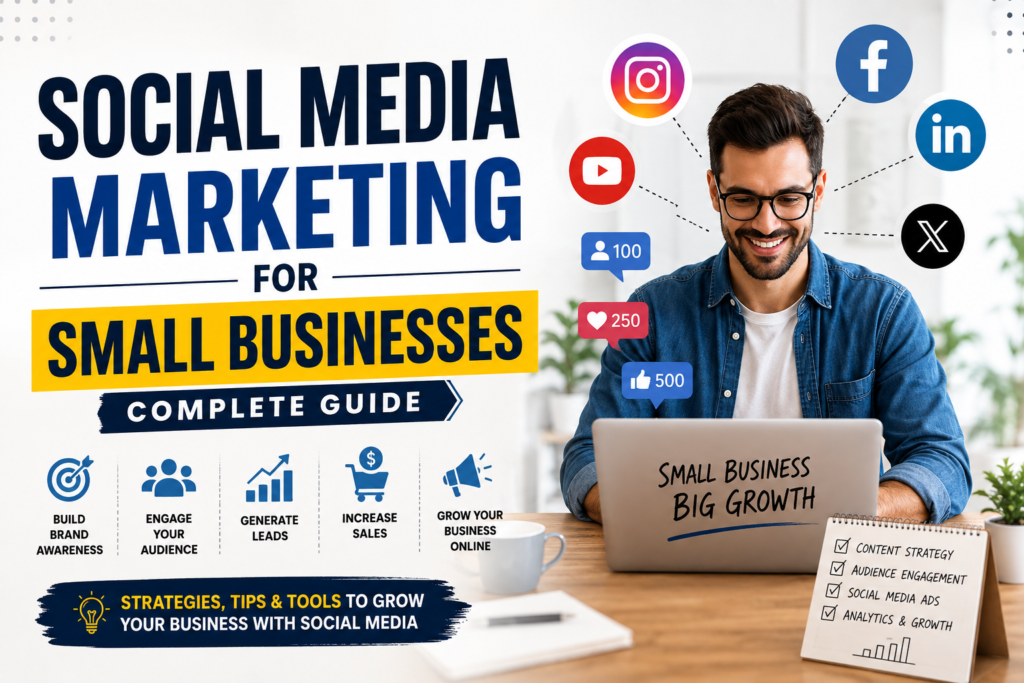
Social media has changed the way small businesses connect with customers. A business no longer needs a huge advertising budget or a large marketing team to build awareness, attract potential customers, and grow its brand. With the right social media marketing strategy, even a small business can reach a highly targeted audience, build trust, generate leads, and increase sales.
Platforms such as Instagram, Facebook, LinkedIn, YouTube, and other social networks give small businesses an opportunity to compete with larger brands by creating useful content and building genuine relationships with their audience.
However, simply creating a social media account and posting occasionally is not enough.
Successful social media marketing for small businesses requires a clear strategy, consistent content, audience research, creative communication, performance tracking, and continuous optimization.
This complete guide explains how small businesses can use social media marketing effectively, which platforms they should consider, what types of content they should create, common mistakes to avoid, and how to build a practical social media strategy that supports long-term business growth.
What Is Social Media Marketing?
Social media marketing is the process of using social media platforms to promote a business, communicate with customers, build brand awareness, generate leads, drive website traffic, and increase sales.
Unlike traditional advertising, social media allows businesses to communicate directly with their audience.
For example, a local business can use social media to:
- Introduce its products or services
- Educate potential customers
- Share customer testimonials
- Showcase its work
- Answer customer questions
- Build brand awareness
- Generate enquiries
- Promote offers
- Drive website traffic
- Build a community
- Run paid advertising campaigns
Social media marketing can include both organic marketing and paid advertising.
Organic marketing involves content such as posts, reels, stories, videos, carousels, and community engagement.
Paid social media marketing involves advertisements designed to reach specific audiences based on factors such as location, interests, demographics, behaviors, and other targeting signals.
For small businesses, combining organic content with carefully planned paid campaigns can create a stronger digital marketing strategy.
Why Social Media Marketing Is Important for Small Businesses
Small businesses often face challenges such as limited budgets, low brand awareness, and strong competition.
Social media can help overcome some of these challenges by providing affordable ways to reach potential customers.
1. Builds Brand Awareness
People are more likely to consider a business they recognize and trust.
Regularly publishing useful and relevant content can help your business stay visible in front of potential customers.
For example, a local salon can publish:
- Hairstyle ideas
- Hair-care tips
- Before-and-after transformations
- Customer testimonials
- Seasonal offers
- Reels demonstrating services
Over time, this content can help customers become familiar with the brand.
2. Helps Build Customer Trust
Customers want to know who they are buying from.
Social media gives small businesses an opportunity to show their personality, expertise, products, services, team, customer experiences, and behind-the-scenes activities.
A professional online presence can make a small business appear more credible and approachable.
3. Generates Leads
Social media can be used to generate enquiries through:
- Direct messages
- Lead forms
- Website traffic
- WhatsApp conversations
- Phone calls
- Landing pages
- Promotional campaigns
A well-designed social media strategy should not focus only on followers. It should ultimately contribute to meaningful business outcomes.
4. Provides Direct Customer Interaction
Social media allows businesses to communicate directly with customers.
Customers can comment on posts, send messages, ask questions, share feedback, and interact with content.
This provides valuable information about customer needs and preferences.
5. Supports Business Growth
When social media content attracts the right audience and builds trust, it can contribute to website visits, enquiries, sales, repeat purchases, and referrals.
The key is to connect social media activity with broader business objectives.
Which Social Media Platforms Should Small Businesses Use?
One of the biggest mistakes small businesses make is trying to be active on every platform.
You don’t necessarily need five or six active social media accounts.
Instead, choose platforms based on your target audience, industry, content format, and business goals.
Instagram is particularly useful for visually driven businesses.
It can be effective for:
- Fashion brands
- Beauty businesses
- Salons
- Restaurants
- Cafes
- Fitness businesses
- Coaches
- Personal brands
- Local businesses
- E-commerce brands
Content formats include:
- Reels
- Carousels
- Images
- Stories
- Live videos
Instagram can help businesses build visual identity and engage audiences through short-form content.
Facebook continues to be useful for many local businesses and communities.
Businesses can use Facebook for:
- Business updates
- Community engagement
- Local promotions
- Videos
- Customer communication
- Events
- Paid advertising
Facebook can be particularly useful for businesses targeting specific geographic areas or demographic groups.
LinkedIn is particularly valuable for B2B companies, professionals, consultants, agencies, recruiters, and personal brands.
Businesses can use LinkedIn to share:
- Industry insights
- Case studies
- Educational content
- Company updates
- Professional opinions
- Customer success stories
- Thought leadership
For B2B businesses, LinkedIn can become an important platform for networking and lead generation.
YouTube
YouTube is useful for businesses that can create educational or entertaining video content.
Examples include:
- Tutorials
- Product demonstrations
- Reviews
- Educational videos
- Interviews
- How-to videos
- Customer stories
Video content can also support search visibility because users frequently use video platforms to find solutions to their problems.
How to Create a Social Media Marketing Strategy
Before posting content, small businesses should create a strategy.
A simple social media strategy can be divided into several steps.
Step 1: Define Your Business Goals
Start by deciding what you want social media to achieve.
Your goals could include:
- Increasing brand awareness
- Generating leads
- Increasing website traffic
- Increasing sales
- Building a community
- Promoting products
- Improving customer engagement
- Establishing industry authority
Your content and measurement system should support these goals.
For example, if your primary objective is lead generation, simply increasing followers may not be enough.
You should track enquiries, leads, clicks, conversions, and cost per lead.
Step 2: Identify Your Target Audience
You cannot create effective content if you don’t know who you’re trying to reach.
Define your ideal customer based on factors such as:
- Age
- Location
- Profession
- Interests
- Income range
- Business type
- Problems
- Buying behavior
- Goals
For example, a digital marketing consultant targeting Mumbai businesses might focus on:
Audience: Small business owners and entrepreneurs
Location: Mumbai
Problems: Low online visibility, low website traffic, inconsistent social media presence, difficulty generating leads
Goals: More enquiries, better brand visibility, increased sales
This information can guide your content strategy.
Step 3: Research Your Competitors
Competitor research can help you understand what is already working in your industry.
Look at:
- Their social media platforms
- Content formats
- Posting frequency
- Engagement
- Topics
- Offers
- Visual identity
- Calls to action
- Customer interactions
Don’t copy competitors.
Instead, identify opportunities to create something more useful, unique, specific, or engaging.
Ask:
What can my business explain better?
What questions are competitors not answering?
which content would be genuinely useful to my customers?
Step 4: Choose Your Content Pillars
Content pillars are the main categories around which your social media content is created.
A small business could use four or five content pillars.
For example, a digital marketing consultant could use:
Educational Content
- SEO tips
- Social media tips
- Marketing strategies
- AI tools
- Content marketing
Business Tips
- Lead generation ideas
- Branding advice
- Online growth strategies
Industry Trends
- Marketing trends
- AI developments
- Social media updates
Trust-Building Content
- Client results
- Testimonials
- Case studies
- Certifications
- Work process
Promotional Content
- Services
- Offers
- Consultation
- Free resources
Having content pillars makes content planning easier and prevents your social media profile from becoming repetitive.
Step 5: Create Valuable Content
One of the most important principles of social media marketing is to create content that provides value.
Instead of constantly saying:
“Buy our product.”
Think about how you can help the customer first.
For example, a skincare business could publish:
“5 Common Skincare Mistakes You Should Avoid.”
A digital marketing consultant could publish:
“5 SEO Mistakes Small Businesses Make.”
A restaurant could publish:
“How We Prepare Our Most Popular Dish.”
Useful content creates opportunities for people to discover and remember your business.
Types of Social Media Content Small Businesses Can Create
A strong social media strategy usually combines multiple content formats.
1. Educational Posts
Educational content teaches customers something useful.
Examples:
- Tips
- Tutorials
- Checklists
- Guides
- How-to posts
- Industry insights
Educational content can help position your business as knowledgeable and trustworthy.
2. Short-Form Videos and Reels
Short-form video is an effective format for communicating ideas quickly.
Businesses can create videos around:
- Tips
- Product demonstrations
- Before-and-after results
- FAQs
- Behind-the-scenes content
- Customer stories
- Industry trends
- Tutorials
The opening seconds are important.
Start with a strong hook that tells viewers why they should continue watching.
For example:
“3 SEO mistakes that could be hurting your website.”
This is more compelling than simply starting with:
“Hello everyone, today we’re going to talk about SEO.”
3. Carousel Posts
Carousels allow businesses to explain a topic across multiple slides.
For example:
5 Social Media Mistakes Small Businesses Should Avoid
1: Hook
2: Posting without a strategy
3: Ignoring the target audience
4: Inconsistent posting
5: Not analyzing results
6: Final takeaway
7: Call to action
Carousels can be particularly useful for educational content.
4. Customer Testimonials
Customer testimonials provide social proof.
You can share:
- Written testimonials
- Video testimonials
- Screenshots of feedback
- Case studies
- Before-and-after results
Always obtain appropriate permission before publishing customer information or screenshots.
5. Behind-the-Scenes Content
People don’t only want to see products.
They also want to see the people and processes behind a business.
You could show:
- Team activities
- Product creation
- Packaging
- Office activities
- Client work
- Daily operations
- Preparation for an event
This can make your brand feel more authentic.
6. User-Generated Content
User-generated content is created by customers rather than the business itself.
Examples include:
- Customer photos
- Customer videos
- Reviews
- Testimonials
- Product experiences
With permission, businesses can repurpose this content on their social channels.
How Often Should a Small Business Post on Social Media?
There is no universal number that guarantees success.
Consistency and quality are more important than posting a specific number of times.
A small business might start with:
- 3–5 feed posts per week
- Regular stories
- 1–3 short-form videos per week
However, the ideal schedule depends on your resources and audience.
If you can create only three high-quality posts per week, that may be better than publishing seven low-quality posts.
The goal is to create a sustainable system.
Create a Social Media Content Calendar
A content calendar helps businesses organize their content in advance.
A simple weekly calendar could look like this:
| Day | Content Type | Example |
|---|---|---|
| Monday | Educational | Industry tip |
| Tuesday | Reel | Quick tutorial |
| Wednesday | Carousel | Common mistakes |
| Thursday | Story | Behind the scenes |
| Friday | Social proof | Customer testimonial |
| Saturday | Promotional | Product/service |
| Sunday | Engagement | Question/poll |
Your actual schedule should be based on your audience and resources.
Planning content in advance can also reduce last-minute posting.
How to Write Better Social Media Captions
A strong caption should support the content rather than simply repeat what’s already visible.
A useful caption structure is:
Hook
Grab attention.
Value
Explain the problem, insight, or solution.
CTA
Tell people what to do next.
For example:
Want more local customers from Google?
Many small businesses create a Google Business Profile but never optimize it properly.
Complete your business information, add relevant services, upload quality photos, encourage genuine reviews, and keep your profile updated.
Save this post and share it with a business owner who needs better local visibility.
This structure is simple but effective.
Use Calls to Action
A call to action tells your audience what to do next.
Examples include:
- Follow for more tips
- Save this post
- Share this with a friend
- Visit our website
- Send us a message
- Book a consultation
- Download the guide
- Get a quote
- Comment below
- Contact us today
Don’t use a sales CTA on every post.
Match the CTA with the purpose of the content.
Educational posts can encourage saves or shares, while promotional posts can encourage enquiries or purchases.
Social Media Advertising for Small Businesses
Organic content is only one part of social media marketing.
Paid advertising can help businesses reach specific audiences more quickly.
Social media advertising platforms allow businesses to create campaigns around objectives such as:
- Brand awareness
- Website traffic
- Engagement
- Lead generation
- Sales
- App promotion
For local businesses, geographic targeting can be particularly useful.
For example, a Mumbai-based business may target customers within selected areas rather than advertising to an entire country.
How Much Should Small Businesses Spend on Social Media Ads?
There is no universal advertising budget.
Your budget should depend on:
- Business goals
- Average customer value
- Competition
- Target audience
- Conversion rate
- Campaign objective
- Available marketing budget
Start with a controlled budget, measure performance, and scale campaigns that generate profitable results.
Don’t increase your advertising budget simply because an advertisement receives many likes.
The important question is:
Does the campaign contribute to the business objective?
Organic Social Media vs Paid Social Media
Both approaches have advantages.
Organic Social Media
Advantages:
- Builds long-term audience relationships
- Creates brand personality
- Can generate ongoing visibility
- Helps establish authority
- Doesn’t require an advertising budget for every post
Paid Social Media
Advantages:
- Faster audience reach
- Advanced targeting options
- Scalable campaigns
- Lead-generation opportunities
- Useful for promotions and product launches
For many small businesses, combining both approaches can be more effective than relying entirely on one.
How to Measure Social Media Marketing Success
Followers are only one metric.
Businesses should monitor metrics that connect social media activity with business objectives.
Important metrics include:
Reach
How many people saw your content?
Impressions
How many times was your content displayed?
Engagement
How many people interacted with your content?
Engagement Rate
How actively your audience interacts with your content.
Website Clicks
How many people visited your website from social media?
Leads
How many enquiries were generated?
Conversions
How many visitors became customers?
Cost Per Lead
How much did you spend to generate each lead from paid campaigns?
Return on Ad Spend
How much revenue was generated compared with advertising expenditure?
The right metrics depend on your goals.
Common Social Media Marketing Mistakes Small Businesses Make
1. Posting Without a Strategy
Posting randomly can make your social media presence inconsistent.
Create content pillars and a calendar.
2. Focusing Only on Followers
A large audience doesn’t automatically mean more revenue.
Focus on attracting the right audience.
3. Being Too Promotional
If every post is an advertisement, people may lose interest.
Balance promotional content with educational, entertaining, and trust-building content.
4. Ignoring Comments and Messages
Social media is about communication.
Respond to genuine comments and customer enquiries.
5. Copying Competitors
Your brand needs its own voice.
Use competitors for research, not imitation.
6. Using Poor-Quality Visuals
Your content represents your brand.
Use readable designs, good-quality images, consistent branding, and clear messaging.
7. Not Tracking Results
Without analytics, you don’t know what is working.
Review your performance regularly.
8. Trying to Be Everywhere
Managing every platform can become overwhelming.
Start with the platforms where your customers are most active.
How to Build a Strong Social Media Brand
A recognizable brand is easier for customers to remember.
Maintain consistency across:
- Logo
- Colors
- Typography
- Photography
- Design style
- Tone of voice
- Content topics
Your profile should also clearly communicate:
Who you help + What you offer + Why customers should trust you
For example:
Helping Mumbai businesses grow through SEO, social media marketing and digital marketing strategies.
This immediately communicates your positioning.
Social Media Marketing for Local Businesses
Local businesses can use social media to strengthen their presence within specific communities.
For example, a Mumbai-based business can create content related to:
- Local events
- Mumbai trends
- Customer stories
- Local offers
- Neighborhood-specific services
- Location-based hashtags
- Community activities
Social media can also work alongside Local SEO.
For example:
Social Media → Website → Google Business Profile → Enquiry
An integrated strategy can create multiple touchpoints between your business and potential customers.
How Social Media and SEO Work Together
Social media and SEO are different marketing channels, but they can support each other.
For example, you publish a blog about:
“SEO Tips for Small Businesses.”
You can then:
- Publish the article on your website.
- Create a LinkedIn post summarizing the article.
- Create an Instagram carousel from the main points.
- Create a short video explaining one tip.
- Share the article through relevant social channels.
One piece of content can therefore become multiple marketing assets.
This is called content repurposing.
It helps small businesses get more value from the content they create.
Social Media Content Repurposing Strategy
You don’t always need to create completely new content every day.
Suppose you write a detailed blog called:
“10 SEO Tips for Small Businesses.”
You can turn it into:
- 1 LinkedIn article
- 1 Instagram carousel
- 3 short videos
- 5 social media posts
- 10 story ideas
- 1 email newsletter
- 1 infographic
This approach saves time and allows businesses to communicate the same valuable idea in different formats.
How AI Can Help Small Businesses With Social Media
Artificial intelligence can help businesses streamline parts of their content workflow.
AI tools can assist with:
- Content ideas
- Caption drafts
- Content calendars
- Research
- Script ideas
- Headline variations
- Repurposing content
- Basic creative concepts
- Data analysis
However, AI-generated content should not simply be published without review.
Your content should reflect:
- Your expertise
- Your brand voice
- Your customers
- Your actual experiences
- Accurate information
AI should support your strategy rather than replace human judgment.
A Simple 30-Day Social Media Strategy
If you’re a small business starting from scratch, you don’t need a complicated plan.
Week 1: Build the Foundation
- Optimize your profiles
- Define your audience
- Identify competitors
- Select your main platforms
- Create content pillars
Week 2: Start Publishing
Publish:
- Educational posts
- Short-form videos
- Customer-focused content
- Brand introduction
- FAQs
Focus on consistency.
Week 3: Build Engagement
Encourage:
- Comments
- Questions
- Polls
- Shares
- Saves
- Direct messages
Respond to your audience.
Week 4: Analyze and Improve
Review:
- Reach
- Engagement
- Website traffic
- Leads
- Best-performing content
- Weak-performing content
Then use the data to plan your next month.
Social Media Marketing Checklist for Small Businesses
Before publishing your next post, ask:
Strategy
- Is this content relevant to my audience?
- Does it support a business goal?
- Does it fit one of my content pillars?
Content
- Does the post provide value?
- Is the message easy to understand?
- Does the opening grab attention?
- Is the visual clear?
Branding
- Is the branding consistent?
- Does the content sound like my business?
- Is the business identity clear?
Engagement
- Is there a relevant CTA?
- Can people easily respond?
- Will the content encourage discussion, saves, or shares?
Performance
- How will I measure success?
- Did similar content perform well previously?
- What can I improve next time?
How Long Does Social Media Marketing Take to Show Results?
Social media marketing is not an overnight solution.
Some businesses may see immediate engagement or enquiries from a successful campaign, while building a strong organic audience and brand presence can take much longer.
Results depend on:
- Industry
- Audience
- Content quality
- Competition
- Posting consistency
- Platform
- Offer
- Advertising budget
- Conversion process
The objective should be to build a sustainable marketing system rather than expecting instant results from a few posts.
Should Small Businesses Hire a Social Media Marketing Expert?
Managing social media can become time-consuming.
A business owner may need to handle:
- Strategy
- Content research
- Copywriting
- Graphic design
- Video editing
- Publishing
- Community management
- Advertising
- Analytics
If these activities take attention away from running the business, working with a social media marketing professional can be useful.
A professional can help create a strategy, manage content, analyze performance, and improve campaigns based on data.
However, businesses should choose a professional based on their expertise, experience, communication, strategy, and understanding of the business—not simply the number of followers they have.
Final Thoughts
Social media marketing for small businesses is no longer just about posting pictures and collecting followers.
It is a strategic marketing channel that can help businesses build awareness, establish trust, communicate with customers, generate leads, drive website traffic, and support sales.
The most successful small businesses don’t necessarily publish the most content. They create content that is relevant to the right audience and connect that content with clear business objectives.
Start by understanding your customers.
Choose the platforms where they are most likely to spend time.
Create useful and engaging content.
Maintain a consistent brand identity.
Respond to your audience.
Use paid advertising when it makes business sense.
Track your performance.
Then improve your strategy based on data.
Most importantly, remember that social media marketing is a long-term process.
Consistency builds visibility. Valuable content builds trust. Strategy turns attention into business growth.
Ready to Grow Your Business With Social Media Marketing?
For small businesses, having a social media presence is only the beginning. The real opportunity comes from creating a strategy that connects content, audience engagement, branding, SEO, advertising, and lead generation.
Digital Adnan Khan helps startups, small businesses, SMEs, and established brands strengthen their online presence through digital marketing, SEO, social media marketing, paid advertising, and result-oriented online growth strategies.
Whether your goal is to build brand awareness, generate qualified leads, improve customer engagement, or establish a stronger digital presence, a structured social media strategy can help you move closer to your business goals.
Start with your audience, create content that solves their problems, and use social media as a tool to build lasting customer relationships—not just collect followers.
Frequently Asked Questions
What is social media marketing for small businesses?
Social media marketing for small businesses involves using platforms such as Instagram, Facebook, LinkedIn, and YouTube to build brand awareness, engage customers, generate leads, promote products or services, and support business growth.
Which social media platform is best for small businesses?
There is no single platform that is best for every business. The right platform depends on your target audience, industry, location, content format, and business objectives. Instagram can be useful for visual businesses, LinkedIn for B2B companies and professionals, Facebook for local communities, and YouTube for businesses focused on video content.
How often should a small business post on social media?
A small business should choose a posting schedule it can maintain consistently. Starting with three to five quality posts per week can be practical for many businesses, but the ideal frequency depends on the platform, audience, content resources, and marketing goals.
Is social media marketing expensive for small businesses?
Social media marketing can be adapted to different budgets. Organic content can be created without paying for advertising, while paid campaigns can start with controlled budgets and be scaled based on performance.
Can social media marketing generate leads?
Yes. Businesses can use social media to generate leads through direct messages, website traffic, lead forms, WhatsApp conversations, landing pages, promotional campaigns, and calls to action.
How long does it take to see social media marketing results?
Results vary depending on the business, audience, content strategy, competition, platform, advertising budget, and offer. Paid campaigns can generate results quickly, while organic brand building and audience growth generally require consistent effort over time.
Should small businesses use paid social media advertising?
Paid advertising can be useful when a business wants to reach a targeted audience, promote a product or service, generate leads, or support a specific campaign. Businesses should track results and focus on measurable outcomes rather than simply increasing reach.
Can social media help with SEO?
Social media and SEO are separate marketing channels, but they can support an overall digital marketing strategy. Social platforms can help distribute content, increase brand awareness, attract website visitors, and create additional opportunities for people to discover a business.
What type of content works best for small businesses?
The best content depends on the audience and industry. Educational posts, short-form videos, carousels, testimonials, product demonstrations, behind-the-scenes content, FAQs, case studies, and useful tips can all be effective when they address customer needs.
How can a small business improve its social media presence?
Start by defining your target audience, selecting relevant platforms, creating content pillars, maintaining consistent branding, publishing valuable content, engaging with followers, using appropriate calls to action, and regularly analyzing performance.