
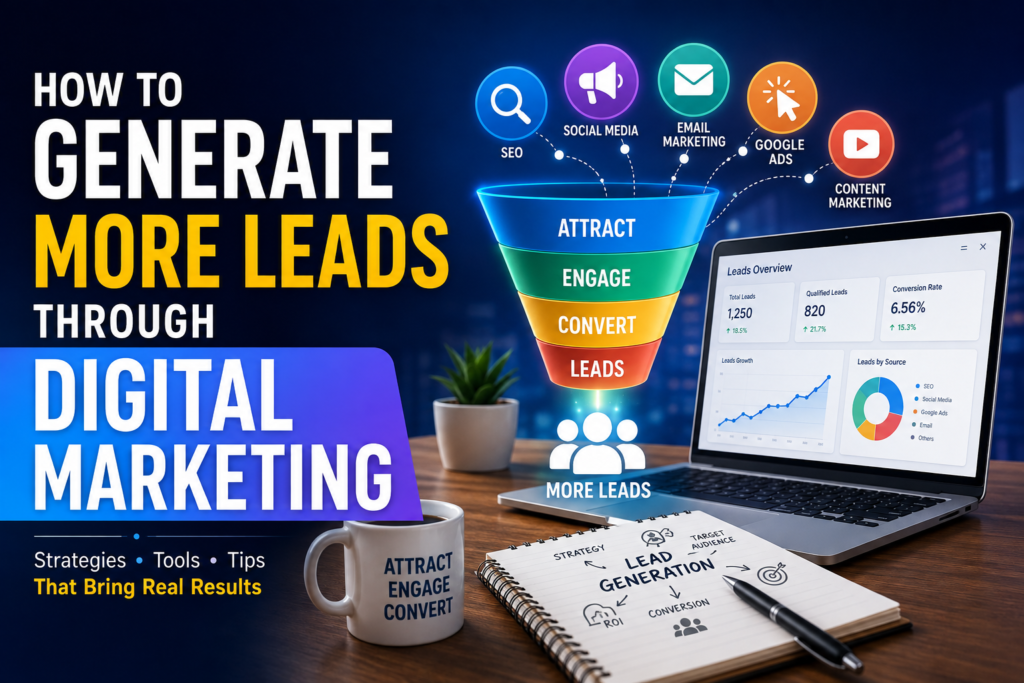
Generating a consistent flow of leads is one of the biggest challenges businesses face today. Whether you run a small local business, startup, professional service, e-commerce company, or established brand, attracting the right customers is essential for sustainable growth.
Traditional marketing methods can still work, but digital marketing provides businesses with more opportunities to reach targeted audiences, measure performance, build relationships, and convert prospects into customers.
From search engine optimization (SEO) and social media marketing to Google Ads, content marketing, email marketing, landing pages, and marketing automation, businesses can use multiple digital channels to generate qualified leads.
However, simply being present online does not guarantee results.
A successful lead generation strategy requires the right combination of target audience research, valuable content, search visibility, paid advertising, conversion optimization, follow-up, and performance analysis.
In this guide, you’ll learn how to generate more leads through digital marketing, which channels are most effective, how to create a lead generation funnel, common mistakes to avoid, and practical strategies businesses can implement to improve their results.
What Is Lead Generation in Digital Marketing?
Lead generation is the process of attracting potential customers and encouraging them to provide their contact information or take a meaningful action that indicates interest in a product or service.
A lead could be someone who:
- Fills out a contact form
- Requests a quotation
- Books a consultation
- Calls a business
- Sends a WhatsApp message
- Subscribes to an email list
- Downloads an ebook or guide
- Registers for a webinar
- Requests a product demonstration
- Creates an account
- Makes an enquiry through social media
The goal is not simply to generate a large number of leads.
The goal is to generate qualified leads that have a genuine possibility of becoming customers.
For example, if a digital marketing consultant receives 100 enquiries but only two are relevant, the campaign may look successful based on lead volume but perform poorly from a business perspective.
On the other hand, 30 highly relevant enquiries could generate significantly more revenue.
This is why effective digital marketing lead generation focuses on:
Traffic → Interest → Lead → Qualification → Conversion → Customer
Why Digital Marketing Is Important for Lead Generation
Digital marketing allows businesses to reach potential customers at different stages of the buying journey.
Someone may discover your business through Google.
Another person may see your Instagram content.
Someone else may click a Google Ad after actively searching for your service.
A potential customer may read your blog before contacting you several days later.
Digital marketing connects these touchpoints.
Some of the biggest advantages include:
Targeted Reach
Businesses can target specific audiences based on location, interests, demographics, search intent, behavior, and other factors.
Measurable Results
Digital channels allow marketers to monitor metrics such as traffic, clicks, leads, conversion rates, and advertising costs.
Multiple Customer Touchpoints
Businesses can interact with prospects through search, websites, social media, email, advertising, and messaging platforms.
Cost Control
Many digital advertising platforms allow businesses to control budgets and adjust campaigns according to performance.
Scalability
Once a campaign or organic strategy starts producing qualified leads, businesses can optimize and scale it.
How Does a Digital Marketing Lead Generation Funnel Work?
Before choosing individual marketing channels, it is important to understand the lead generation funnel.
A typical funnel includes five stages:
1. Awareness
At this stage, potential customers become aware of your brand.
They may discover you through:
- Google Search
- YouTube
- Blogs
- Online advertisements
- Recommendations
The goal is to attract relevant attention.
2. Interest
The prospect starts researching a problem, service, product, or solution.
They may visit your website, read your blog, watch a video, or follow your social media account.
Your goal is to demonstrate relevance and expertise.
3. Consideration
The prospect compares different solutions.
They may check:
- Pricing
- Reviews
- Case studies
- Testimonials
- Services
- Features
- Experience
- Results
This is where trust becomes extremely important.
4. Conversion
The prospect takes an action such as:
- Filling out a form
- Calling
- Booking an appointment
- Requesting a quote
- Sending a message
They become a lead.
5. Nurturing and Sales
Not every lead is ready to buy immediately.
Some need additional information, follow-ups, demonstrations, or consultations.
Lead nurturing helps move potential customers toward a purchase decision.
1. Define Your Ideal Customer Before Generating Leads
One of the biggest mistakes businesses make is trying to market to everyone.
Before launching a lead generation campaign, define your ideal customer.
Ask:
- Who is most likely to buy?
- What problem are they experiencing?
- What service or product do they need?
- Where do they search for solutions?
- What objections might they have?
- What factors influence their buying decision?
- What is their budget?
- What location do they serve?
For example, a local digital marketing consultant may target:
Small and medium-sized businesses in Mumbai looking for SEO, social media marketing, paid advertising, and online lead generation.
This is more useful than simply targeting:
Everyone interested in digital marketing.
A clearly defined audience helps improve messaging, targeting, content, and advertising performance.
2. Build a High-Converting Website
Your website is often one of the most important components of your digital lead generation system.
You can generate thousands of visitors, but if your website doesn’t convince them to take action, those visitors may not become leads.
Your website should clearly communicate:
- What you offer
- Who you help
- What problems you solve
- Why customers should choose you
- What results or benefits you provide
- How visitors can contact you
Important Website Elements
Include:
- Clear headline
- Strong value proposition
- Service information
- Benefits
- Testimonials
- Case studies
- Trust signals
- Relevant images
- FAQs
- Contact information
- Clear calls to action
For example, instead of a generic headline:
Digital Marketing Services
use a more specific message:
Result-Driven Digital Marketing Strategies to Help Businesses Generate More Leads and Grow Online
The second message communicates a clearer outcome.
3. Use SEO to Generate Consistent Organic Leads
Search engine optimization is one of the most valuable long-term lead generation strategies.
SEO helps your website appear when potential customers search for products, services, problems, or solutions related to your business.
For example, a Mumbai-based digital marketing consultant could target searches such as:
- Digital marketing consultant in Mumbai
- SEO consultant in Mumbai
- Digital marketing services in Mumbai
- SEO services for small businesses
- Social media marketing services
- Local SEO services
The key is to target keywords that demonstrate commercial or transactional intent.
Someone searching:
“What is digital marketing?”
may simply be researching.
Someone searching:
“Digital marketing consultant near me”
is more likely to be looking for a service provider.
Both keywords can be useful, but they serve different stages of the funnel.
4. Focus on Search Intent
Keyword research should not be based only on search volume.
You also need to understand why someone is searching.
There are four common types of search intent:
Informational Intent
The user wants information.
Example:
How does SEO work?
Navigational Intent
The user wants to find a specific website or brand.
Example:
Google Search Console login
Commercial Investigation
The user is comparing options.
Example:
Best SEO agency for small businesses
Transactional Intent
The user is ready to take action.
Example:
SEO consultant in Mumbai
For lead generation, commercial and transactional keywords are especially valuable.
However, informational content can help attract prospects earlier in the buying journey and move them toward conversion.
5. Create High-Value Content
Content marketing can attract potential customers before they are ready to contact you.
Instead of constantly promoting your products or services, create content that solves customer problems.
Examples include:
- Blog posts
- Guides
- Tutorials
- Case studies
- Checklists
- Videos
- Webinars
- Infographics
- Social media posts
- Industry reports
For example, an SEO consultant could publish:
“How to Get Your Business on the First Page of Google”
At the end of the article, readers could be encouraged to request an SEO consultation.
This creates a natural journey:
Search → Blog → Expertise → Trust → Consultation → Lead
6. Create Lead Magnets
A lead magnet is a useful resource offered in exchange for contact information.
Examples include:
- Free SEO checklist
- Digital marketing strategy template
- Social media calendar
- Marketing audit
- Ebook
- Industry report
- Free consultation
- Website audit
- SEO checklist
- Advertising checklist
For example:
“Download Our Free 30-Point SEO Checklist for Small Businesses.”
A visitor enters their email address and receives the resource.
The business now has an opportunity to nurture that prospect.
The lead magnet should solve a real problem rather than simply being promotional material.
7. Use Social Media to Generate Leads
Social media is more than a platform for likes and followers.
When used strategically, it can become a lead generation channel.
Platforms such as Instagram, Facebook, LinkedIn, and YouTube allow businesses to build awareness, demonstrate expertise, engage with prospects, and drive traffic toward conversion points.
Social Media Lead Generation Strategy
Use a combination of:
Educational Content
Teach your audience something useful.
Problem-Solution Content
Identify a problem and explain how to solve it.
Proof Content
Show testimonials, case studies, results, or customer experiences.
Engagement Content
Ask questions and encourage discussion.
Conversion Content
Invite users to book a consultation, visit your website, request information, or send a message.
A common mistake is posting only promotional content.
People are more likely to engage with a brand when it provides value consistently.
8. Use LinkedIn for B2B Lead Generation
For B2B businesses, LinkedIn can be particularly useful.
Businesses can use LinkedIn to:
- Build personal brands
- Publish educational content
- Connect with decision-makers
- Share case studies
- Participate in industry discussions
- Generate enquiries
- Promote professional services
A strong LinkedIn strategy should not rely entirely on direct selling.
Instead, demonstrate expertise.
For example, a digital marketing consultant can post:
“5 SEO mistakes costing small businesses potential customers.”
The post provides value and establishes expertise.
The call to action can then invite business owners to request an SEO audit or consultation.
9. Use Google Ads for High-Intent Leads
SEO can take time to build.
Google Ads can provide businesses with immediate visibility for relevant searches when campaigns are properly structured.
For example:
“SEO consultant in Mumbai”
has strong commercial intent.
A business could create a search campaign targeting relevant service keywords and direct users to a dedicated landing page.
However, successful Google Ads campaigns require more than choosing keywords.
You also need:
- Relevant ad copy
- Appropriate targeting
- Negative keywords
- Strong landing pages
- Conversion tracking
- Budget management
- Continuous optimization
The goal should be profitable leads, not simply clicks.
10. Create Dedicated Landing Pages
One of the most effective ways to improve lead generation is to create dedicated landing pages.
Instead of sending every advertisement to your homepage, create a page specifically designed for the campaign.
For example:
Google Ads → SEO Services Landing Page
The landing page can include:
- Specific headline
- Problem statement
- Service benefits
- Process
- Testimonials
- Case studies
- FAQs
- Contact form
- Strong CTA
The page should have a clear purpose.
If the objective is lead generation, avoid distracting visitors with unnecessary navigation or unrelated information.
11. Write Better Calls to Action
A call to action tells the visitor what to do next.
Weak CTAs include:
Submit
Click Here
Learn More
More specific CTAs can communicate value.
Examples:
- Get Your Free SEO Audit
- Book a Free Consultation
- Request a Quote
- Get Your Marketing Strategy
- Schedule a Discovery Call
- Download the Free Guide
- Get a Website Audit
Your CTA should match the user’s stage in the buying journey.
A visitor reading an introductory blog may not be ready to “Buy Now.”
A consultation or free guide may be more appropriate.
12. Use Email Marketing for Lead Nurturing
Generating a lead is not the end of the process.
Some prospects need time before making a purchase.
Email marketing can help businesses stay connected with those prospects.
A basic lead nurturing sequence could include:
Email 1: Welcome
Introduce the business and provide the promised resource.
Email 2: Education
Share useful information related to the customer’s problem.
Email 3: Problem
Explain common mistakes and consequences.
Email 4: Solution
Explain how your service or product addresses the problem.
Email 5: Proof
Share testimonials, results, or case studies.
Email 6: Offer
Invite the prospect to book a consultation or purchase.
The sequence should be helpful rather than overly promotional.
13. Use Retargeting to Recover Lost Leads
Many website visitors won’t convert on their first visit.
Retargeting allows businesses to reconnect with people who have previously interacted with their website or content, subject to platform rules and applicable privacy requirements.
For example:
A user visits your SEO services page but doesn’t submit the enquiry form.
Later, they may see another advertisement reminding them about your service.
Retargeting can help maintain brand visibility while prospects continue researching.
However, businesses should use frequency controls and responsible targeting practices to avoid overwhelming users.
14. Use Video Marketing for Lead Generation
Video is an effective way to demonstrate expertise and build trust.
Businesses can create:
- Tutorials
- Product demonstrations
- Customer testimonials
- Case studies
- Expert videos
- FAQs
- Behind-the-scenes videos
- Short educational videos
For example:
“3 SEO Mistakes That Can Stop Your Business From Getting Google Traffic.”
A short video can attract attention and direct viewers to a detailed blog post or consultation page.
Video can also help humanize a business.
People often want to know who is behind a brand before making a purchase decision.
15. Use Local SEO for Local Leads
If you serve customers in a specific geographic area, local SEO can be extremely valuable.
For example, a business operating in Mumbai can optimize for relevant local searches.
Important local SEO activities include:
- Optimizing your Google Business Profile
- Maintaining accurate business information
- Creating location-specific website content
- Building relevant local citations
- Collecting genuine customer reviews
- Creating local service pages
- Earning relevant local backlinks
- Publishing useful location-focused content
A local search such as:
“digital marketing consultant in Andheri”
can demonstrate strong commercial intent.
Local SEO helps businesses reach people who are geographically relevant.
16. Build Trust With Reviews and Testimonials
People are more likely to enquire when they trust a business.
Trust signals can include:
- Customer reviews
- Testimonials
- Case studies
- Certifications
- Awards
- Industry experience
- Client logos where permitted
- Media mentions
- Portfolio examples
- Professional profiles
Don’t simply claim:
“We provide the best digital marketing services.”
Instead, demonstrate why customers should trust you.
For example:
“See how our SEO strategy helped a local business improve its organic visibility.”
Specific evidence is generally more persuasive than generic claims.
17. Use Case Studies to Convert High-Intent Visitors
Case studies can be powerful lead generation assets.
A good case study should explain:
The Problem
What challenge did the client face?
The Strategy
What approach was implemented?
The Execution
What activities were performed?
The Outcome
What measurable results were achieved?
The Lesson
What can other businesses learn from the experience?
For example:
Challenge → SEO audit → Content strategy → Technical improvements → Local SEO → Improved visibility → Increased enquiries
Case studies help prospects understand how your service works in the real world.
18. Improve Your Website Conversion Rate
Generating more traffic isn’t always the answer.
Sometimes the better opportunity is converting more of your existing traffic.
Suppose your website receives:
10,000 visitors per month
and generates:
100 leads
Your conversion rate is 1%.
If you improve the conversion rate to 2%, you could generate:
200 leads from the same traffic.
Conversion optimization can involve:
- Better headlines
- Stronger CTAs
- Shorter forms
- Better landing pages
- Testimonials
- Trust signals
- Faster website performance
- Better mobile experience
- Clearer service descriptions
- Improved page structure
This is why lead generation and conversion rate optimization should work together.
19. Simplify Your Lead Forms
Long forms can discourage prospects.
Only ask for information that you genuinely need.
For a simple consultation request, you might ask for:
- Name
- Phone
- Business
- Requirement
You can collect additional information later.
However, the ideal form length depends on the business and lead quality requirements.
Sometimes additional fields help sales teams qualify prospects.
The key is finding the right balance between:
Conversion rate + Lead quality
20. Use WhatsApp and Messaging for Lead Generation
For businesses serving customers in markets where messaging is widely used, direct messaging can be an effective conversion channel.
Instead of forcing visitors through multiple pages, a website can provide a clear option to start a conversation.
For example:
“Have questions about our digital marketing services? Message us on WhatsApp.”
Messaging can be useful for:
- Service enquiries
- Appointment requests
- Product questions
- Quotations
- Customer support
- Lead qualification
However, businesses should provide clear information and respond promptly.
21. Use AI to Improve Lead Generation
Artificial intelligence is increasingly becoming part of digital marketing workflows.
Businesses can use AI to assist with:
- Customer research
- Content ideas
- Keyword analysis
- Ad copy variations
- Lead scoring
- Personalization
- Chatbots
- Data analysis
- Email campaigns
- Content repurposing
- Customer segmentation
For example, AI can help identify patterns in campaign data and suggest which audiences or content themes may deserve further testing.
AI should be treated as a productivity and decision-support tool rather than a replacement for strategy.
Human review remains important for accuracy, brand voice, customer experience, and business decisions.
22. Track the Right Lead Generation Metrics
If you don’t measure your campaigns, you won’t know what is working.
Important metrics include:
Website Traffic
How many people are visiting your website?
Lead Conversion Rate
What percentage of visitors become leads?
Cost Per Lead
How much are you spending to generate each lead?
Qualified Lead Rate
What percentage of leads meet your target criteria?
Customer Acquisition Cost
How much does it cost to acquire a paying customer?
Conversion Rate
How many leads become customers?
Return on Investment
How much revenue is generated relative to marketing investment?
Don’t focus only on traffic or social media followers.
A campaign with fewer visitors but highly qualified leads can be more valuable than a campaign generating large amounts of low-quality traffic.
23. Calculate Cost Per Lead
Cost per lead is a useful metric for paid campaigns.
The basic formula is:
Cost Per Lead = Total Marketing Spend ÷ Number of Leads
For example:
If you spend ₹50,000 on a campaign and generate 100 leads:
₹50,000 ÷ 100 = ₹500 per lead
But ₹500 per lead doesn’t automatically mean the campaign is successful.
You also need to understand lead quality and customer conversion.
If only one of those 100 leads becomes a customer, the campaign may be inefficient.
If 20 become customers, the economics may be very different.
24. Focus on Qualified Leads, Not Just Lead Volume
A common mistake is celebrating every enquiry.
But not all leads are equal.
A qualified lead should generally match important criteria such as:
- Relevant need
- Appropriate location
- Suitable budget
- Decision-making authority
- Reasonable buying timeframe
For B2B services, businesses can use a lead qualification system to prioritize opportunities.
For example:
Hot Lead: Ready to buy
Warm Lead: Interested but needs more information
Cold Lead: Early-stage researcher
This allows sales teams to prioritize follow-up.
25. Align Marketing and Sales
Marketing generates leads.
Sales converts qualified opportunities into customers.
If these teams work separately, valuable leads can be lost.
Marketing should understand:
- Which leads are converting
- Which channels produce quality leads
- What objections sales teams hear
- What questions prospects ask
- Why leads don’t convert
Sales teams should provide feedback about lead quality.
This creates a continuous improvement loop:
Marketing → Leads → Sales → Customer Feedback → Marketing Optimization
26. Follow Up Quickly
A good lead can become a lost opportunity if nobody follows up.
Create a clear follow-up process.
For example:
1: Lead receives immediate acknowledgement.
2: Sales representative contacts the lead.
3: Requirement is understood.
4: Appropriate solution is recommended.
5: Follow-up is scheduled.
6: Proposal or quotation is sent if appropriate.
Step 7: Prospect is nurtured until a decision is made.
Automation can help organize this process, but human communication remains important for high-value sales.
27. Build a Multi-Channel Lead Generation Strategy
Don’t depend entirely on one platform.
A strong strategy may combine:
SEO
For long-term organic visibility.
Google Ads
For high-intent searches.
Social Media
For awareness and engagement.
Content Marketing
For education and trust.
Email Marketing
For lead nurturing.
Local SEO
For location-based searches.
Video Marketing
For authority and engagement.
Retargeting
For reconnecting with previous visitors.
Each channel serves a different purpose.
The best combination depends on your audience, industry, budget, location, and sales cycle.
28. Common Digital Marketing Lead Generation Mistakes
Mistake 1: Targeting Everyone
A broad audience can produce irrelevant leads.
Solution: Define your ideal customer.
Mistake 2: Focusing Only on Traffic
Traffic doesn’t automatically generate revenue.
Solution: Measure conversions and lead quality.
Mistake 3: Using a Weak CTA
Visitors may not know what to do next.
Solution: Use clear, benefit-oriented CTAs.
Mistake 4: Sending All Traffic to the Homepage
Generic pages may not match campaign intent.
Solution: Create dedicated landing pages.
Mistake 5: Ignoring Mobile Users
Many potential customers browse through smartphones.
Solution: Optimize the website for mobile.
Mistake 6: Buying Low-Quality Leads
Cheap leads can waste sales resources.
Solution: Focus on qualified prospects.
Mistake 7: Not Following Up
Good leads can disappear without timely communication.
Solution: Create a structured follow-up process.
Mistake 8: Relying Only on One Channel
Algorithm changes or rising advertising costs can affect performance.
Solution: Build a diversified acquisition strategy.
29. A Practical Digital Marketing Lead Generation Strategy
If you’re starting from scratch, use this framework.
Step 1: Define Your Audience
Identify your ideal customer and their biggest problems.
Step 2: Research Keywords
Find relevant informational, commercial, and transactional keywords.
Step 3: Optimize Your Website
Create clear service pages and conversion-focused landing pages.
Step 4: Start Content Marketing
Publish useful blogs, guides, videos, and social media content.
Step 5: Build SEO
Optimize your website for relevant searches and create topical authority.
Step 6: Launch Paid Campaigns
Use Google Ads or relevant social advertising platforms when appropriate.
Step 7: Add Lead Magnets
Offer valuable resources that encourage prospects to provide contact information.
Step 8: Nurture Leads
Use email, messaging, remarketing, and personal follow-ups.
Step 9: Track Performance
Measure leads, qualified leads, conversion rates, costs, and revenue.
Step 10: Optimize
Keep improving your campaigns based on actual performance data.
30. How to Generate More Leads With a Limited Budget
You don’t necessarily need a large marketing budget.
Small businesses can start with strategies that rely more heavily on organic growth.
Prioritize Local SEO
Optimize your Google Business Profile and local website pages.
Publish Educational Content
Answer questions your customers are already asking.
Use Organic Social Media
Share practical tips, examples, case studies, and customer stories.
Build Referral Systems
Encourage satisfied customers to recommend your business.
Repurpose Content
Turn one blog into multiple social media posts and videos.
Improve Existing Pages
Optimize pages that already receive traffic.
Focus on High-Intent Keywords
Target searches that demonstrate a strong need for your product or service.
The goal isn’t to do everything at once.
Choose the channels that match your audience and resources.
31. How to Generate B2B Leads Through Digital Marketing
B2B lead generation often requires more education and nurturing because buying decisions can involve multiple people.
Effective B2B strategies include:
- LinkedIn marketing
- SEO
- Industry-specific content
- Case studies
- Webinars
- Email marketing
- Google Ads
- Lead magnets
- Professional networking
- Account-based marketing
B2B buyers often research extensively before contacting a company.
Your website should therefore answer questions about:
- Expertise
- Services
- Pricing approach
- Process
- Experience
- Results
- Customer fit
- Implementation
The more uncertainty you remove, the easier it becomes for prospects to take the next step.
32. How Local Businesses Can Generate More Leads
Local businesses should focus on geographic relevance.
For example:
A salon, clinic, restaurant, consultant, real estate professional, trainer, or agency can benefit from local search visibility.
Key strategies include:
- Google Business Profile optimization
- Local keyword targeting
- Reviews
- Local content
- Location pages
- Local backlinks
- Social media
- Click-to-call CTAs
- WhatsApp enquiries
- Local Google Ads
A local business doesn’t necessarily need millions of website visitors.
It needs the right people in its service area.
33. How to Turn Website Visitors Into Leads
Getting visitors is only the first step.
Use this conversion framework:
Attention
Create a strong headline.
Relevance
Explain how you solve the visitor’s problem.
Trust
Show testimonials, experience, case studies, certifications, and evidence.
Value
Explain the benefits of your solution.
Action
Provide a clear CTA.
Follow-Up
Stay connected if the visitor isn’t ready to buy immediately.
This simple framework can help transform a passive website into a lead generation asset.
34. The Role of Personal Branding in Lead Generation
For consultants, freelancers, coaches, marketers, creators, and service professionals, personal branding can significantly support lead generation.
People don’t only buy services.
They buy expertise and trust.
Build your personal brand by consistently sharing:
- Knowledge
- Experience
- Opinions
- Case studies
- Lessons
- Industry insights
- Practical advice
For example, a digital marketing consultant can publish content about SEO, social media, AI marketing, advertising, and business growth.
Over time, this can position the professional as a trusted resource.
Personal branding works particularly well when combined with SEO and social media.
35. Future of Digital Marketing Lead Generation
Digital marketing lead generation will continue evolving as customer behavior, search, AI, advertising platforms, and technology change.
Businesses should pay attention to:
- AI-powered search
- AI-assisted content creation
- Conversational marketing
- Personalization
- Marketing automation
- Short-form video
- First-party data
- Local search
- Conversion rate optimization
- Customer experience
However, the fundamentals remain the same.
Businesses need to:
Understand customers → Provide value → Build trust → Make discovery easy → Create a simple conversion path → Follow up → Measure results
Technology changes.
Customer needs remain at the center.
Frequently Asked Questions
What is the best way to generate leads through digital marketing?
There is no single best channel for every business. SEO, Google Ads, social media, content marketing, email marketing, local SEO, and landing pages can all generate leads. The best strategy depends on your target audience, industry, location, budget, and sales cycle.
How can I generate leads without spending a lot of money?
Start with organic strategies such as SEO, local SEO, content marketing, social media, email marketing, referrals, and personal branding. Improving the conversion rate of your existing website traffic can also generate more leads without significantly increasing traffic acquisition costs.
How does SEO help generate leads?
SEO helps your business appear when potential customers search for relevant products, services, problems, and solutions. By targeting high-intent keywords and creating useful content, SEO can attract prospects who are actively researching or looking for a solution.
Is Google Ads good for lead generation?
Google Ads can be effective for lead generation because businesses can target searches with strong commercial intent. However, campaign success depends on keyword selection, ad relevance, landing-page quality, conversion tracking, budget management, and lead quality.
How can social media generate leads?
Social media can generate leads through educational content, videos, testimonials, direct messages, lead forms, advertisements, and links to conversion-focused landing pages. The most effective strategy combines value-driven content with clear calls to action.
What is a qualified lead?
A qualified lead is a potential customer who meets important criteria such as having a relevant need, suitable budget, appropriate location, decision-making ability, or realistic buying intent. Qualification criteria vary by business.
How can I improve my lead conversion rate?
Improve your headlines, calls to action, landing pages, website speed, mobile experience, trust signals, testimonials, forms, and follow-up process. Test different approaches and use conversion data to determine what works best.
How important is a landing page for lead generation?
Landing pages are important because they allow businesses to create a focused experience around a specific campaign, service, product, or offer. A well-designed landing page can improve the relevance between an advertisement or search query and the conversion action.
How quickly can digital marketing generate leads?
The timeline depends on the channel. Paid advertising can potentially generate enquiries shortly after campaigns launch, while SEO and organic content generally require more time to build visibility and authority. Results also depend on competition, market demand, budget, strategy, and execution.
Can AI help generate leads?
Yes. AI can assist with customer research, content creation, personalization, chatbots, lead scoring, advertising optimization, data analysis, and marketing automation. Businesses should still use human oversight for strategy, accuracy, customer communication, and decision-making.
Final Thoughts
Generating more leads through digital marketing is not about being present on every platform.
It is about creating a system that consistently attracts the right audience, builds trust, and makes it easy for potential customers to take the next step.
A successful lead generation strategy can combine:
SEO + Content Marketing + Social Media + Google Ads + Landing Pages + Email Marketing + Local SEO + Retargeting + Conversion Optimization
But the foundation is always the same.
Understand your audience.
Create valuable content.
Be visible where your customers search.
Build credibility.
Provide a clear reason to take action.
Follow up consistently.
And measure what actually produces business results.
For small businesses and growing brands, the biggest opportunity is often not simply generating more traffic. It is generating better-quality traffic and converting more of that traffic into qualified leads.
When digital marketing is treated as an integrated system rather than a collection of disconnected activities, businesses can build a more predictable path from online visibility to enquiries, customers, and long-term growth.
About the Author
Digital Adnan Khan is a certified digital marketing consultant specializing in SEO, digital marketing, social media marketing, paid advertising, and online growth strategies. He helps startups, small businesses, SMEs, and established brands strengthen their online presence through practical, result-oriented digital marketing strategies.
For businesses looking to generate more leads, the right combination of SEO, content marketing, social media, paid advertising, conversion optimization, and customer-focused strategy can create a stronger foundation for sustainable online growth.